
YC SP.#004Squash · 2026.09.17
Moving well in the first two games of squash, then heavy legs in game three?
The graphics in this post are in Chinese. The text below is an English translation.
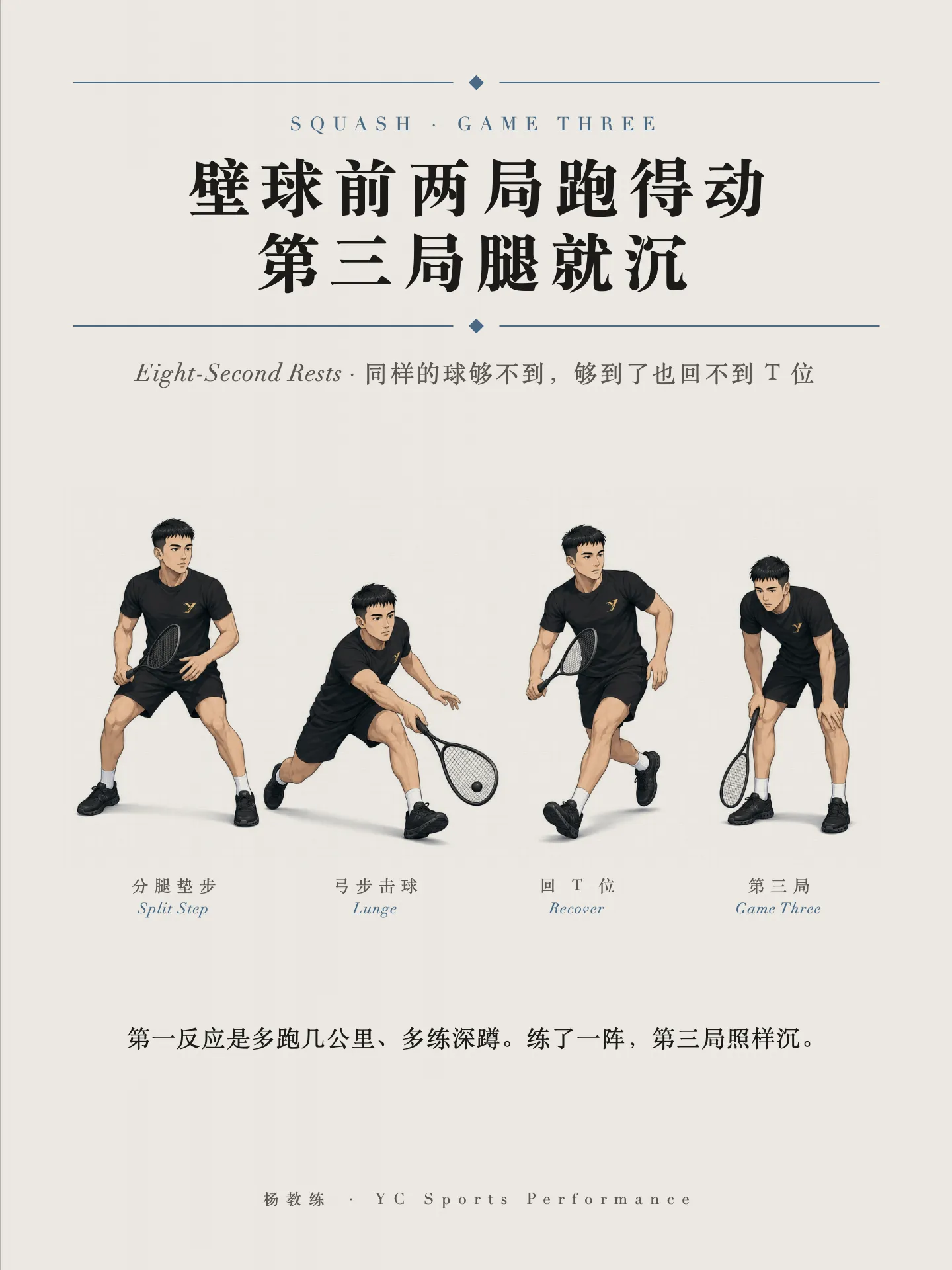



Many squash players know this feeling: in the first two games you're moving well and getting to the ball quickly, then in the third game your legs start to feel heavy. You can't reach the same balls, and when you do, you can't get back to the T. The usual first reaction is one of two things: run more kilometres, or do more squats. After a while of that, the third game is just as heavy. Why?
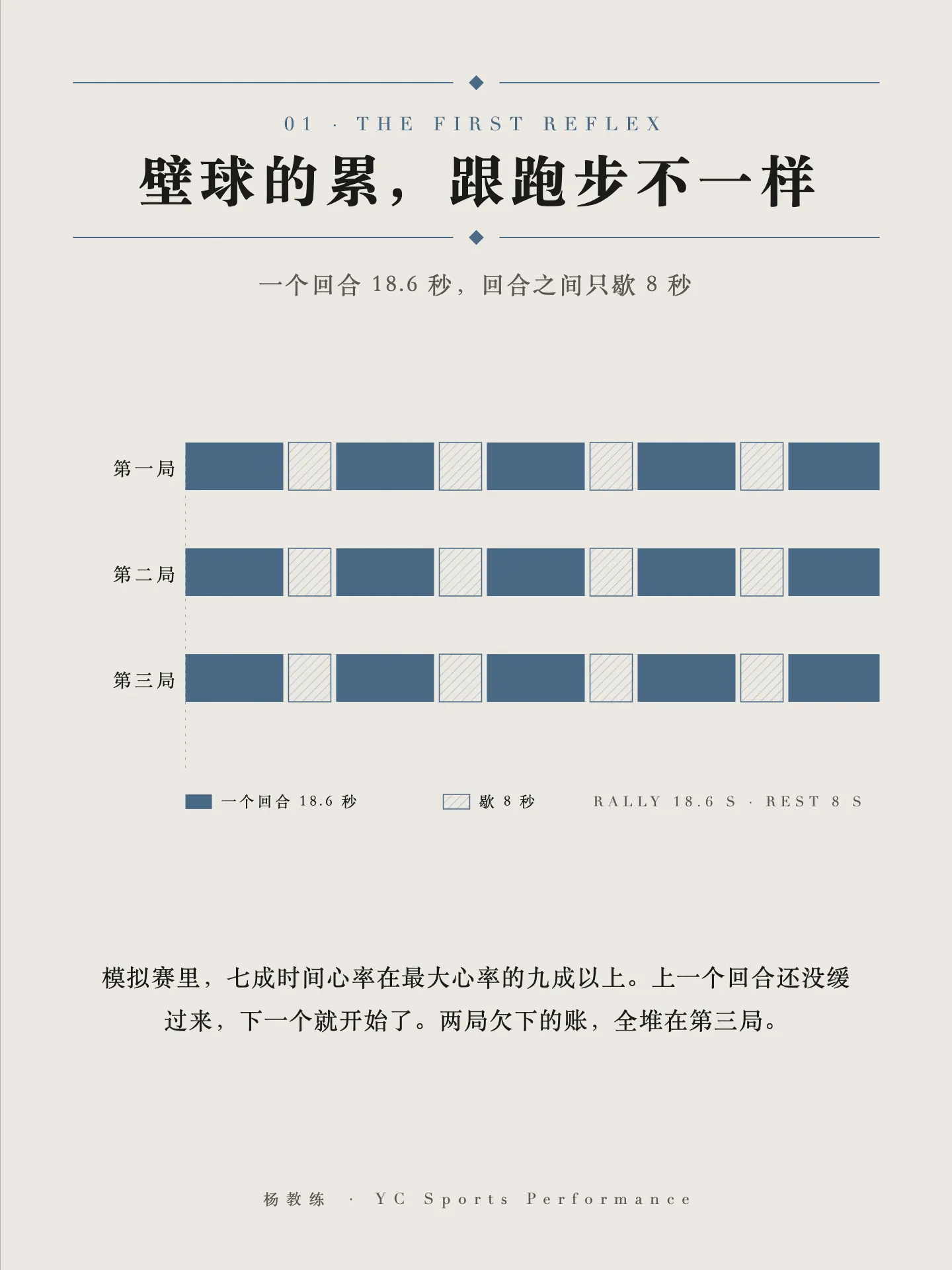
Because fatigue in squash is a different thing from fatigue in running. The court is only 9.75 m long, and the T is two or three steps from any corner. A rally lasts 18.6 s on average, with only 8 s of rest between rallies on average. When 7 players from the national squad's top 25, including the world number one at the time, played simulated matches, their heart rate was above 90% of maximum for 70% of the match, and lactate built up to over 8. You haven't recovered from one rally before the next one starts. The debt from the first two games all piles up in the third.
Running is steady-paced, so the load on your legs is even. In squash, every shot is played off a lunge, and on that step into the front corner, your front leg has to brake your whole body. A match means hundreds of lunges; the braking load stacks up one lunge at a time, and by the third game your legs go dead. You still have strength, you just can't brake any more.
England's squash squad tested 31 players, from the senior squad down to the development squads. The senior squad was better on every measure: they jumped higher, rebounded off the ground faster, changed direction faster and held up better over repeated sprints. There was only one test where they were no better: the endurance test. What was most closely related to ranking? Repeated-sprint ability, and change-of-direction speed. Of course you need endurance, but squash needs the kind where you start again and again over short distances with only a few seconds' rest in between, and steady long-distance running can't give you that.
So what should you train? Four things.
Recovery between rallies: intervals of 20 s fast, 10 s slow, training you to keep moving before you've recovered.
Front-leg braking: make the lunge your main lift, with split squats, Bulgarian split squats and lateral lunges, keeping the lowering phase slow.
Repeated starts: from the T, two or three steps to the ball and back, a dozen or more reps per set, with only a few seconds' rest in between.
Inner thighs and ankles: on the step into the front corner, the inner thigh takes all the tension; it's the most commonly injured area, so train it every session.
When your legs are heavy in the third game, what's usually missing is recovery between rallies and front-leg braking, and long runs won't fix that.
Are you still getting to the ball quickly in game three? Tell me in the comments and I'll see whether it's a recovery problem or a braking problem.
Back to all daily posts