
YC SP.#005Fencing · 2026.09.18
Why your fencing footwork falls apart after a few attacks, even with a fast first step
The graphics in this post are in Chinese. The text below is an English translation.
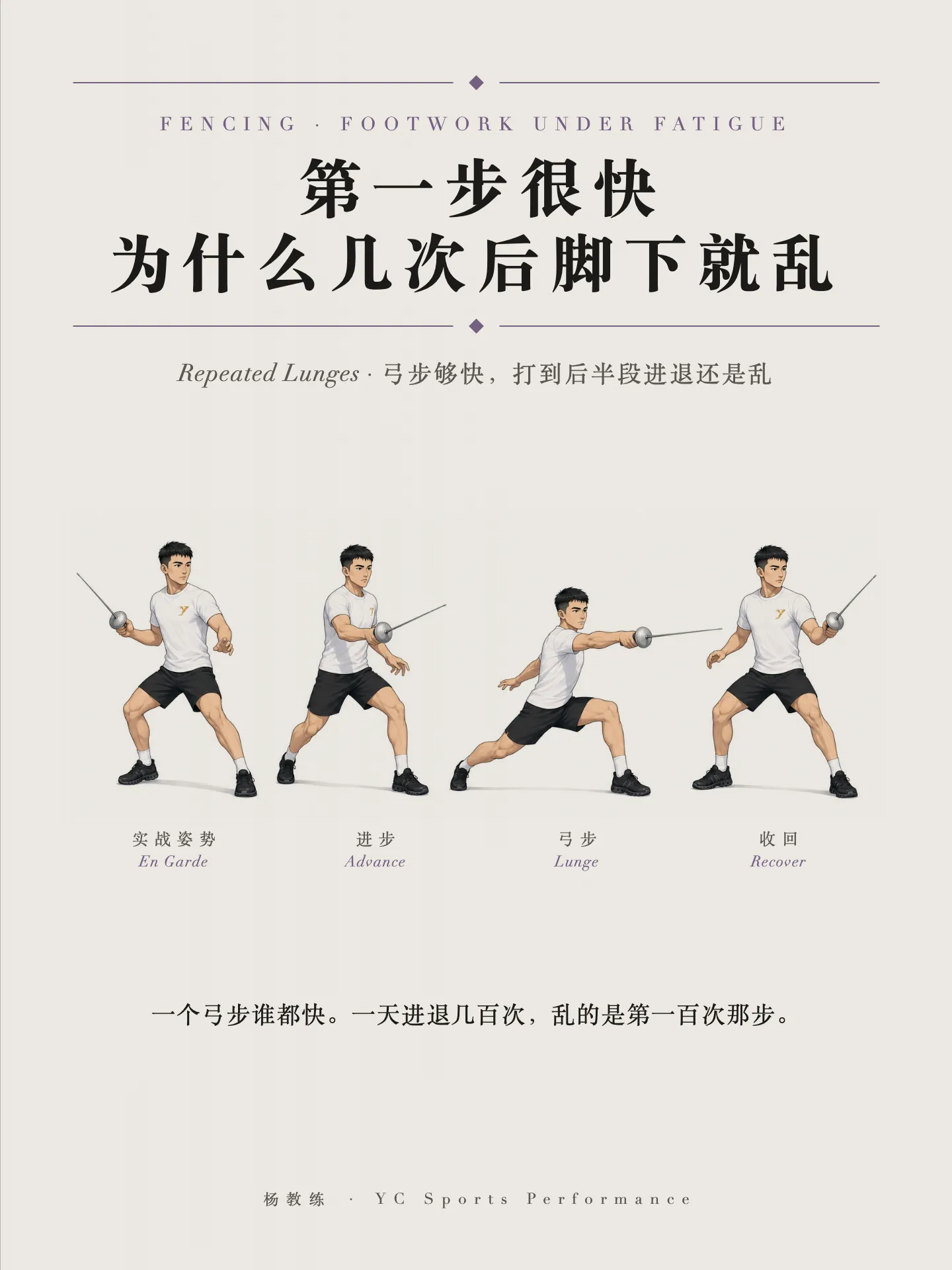




Many young fencers and their parents have an intuitive belief: if the first step is fast enough and the lunge is explosive enough, the footwork will be fine. So when the footwork gets messy, the first reaction is to drill more lunges or train the legs more. But even once a single lunge is faster, by the second half of a bout the advances and retreats still fall apart. Why?
Because competition never tests just one lunge. Look at the records from a one-day direct-elimination event: the winner fights 6 bouts in a day, and in men's épée that means 96 to 180 attacks and 102 to 294 changes of direction in a day. Each exchange lasts 6 s on average in foil and 18 s in épée, then 15 s of rest, then go again. A fast first step is one effort; messy footwork is the hundredth effort.
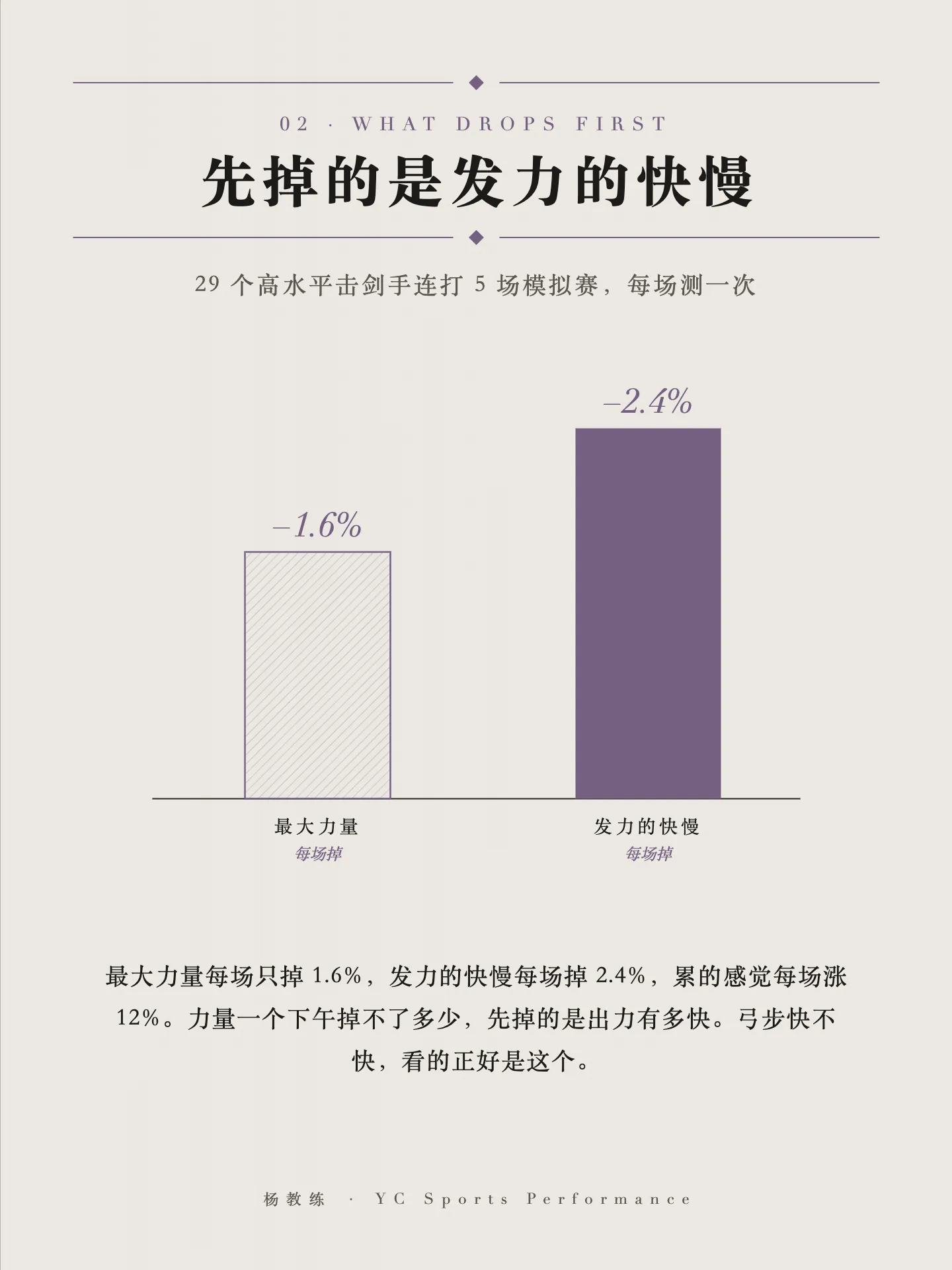
Researchers have measured what goes first when you're tired. 29 high-level fencers fought 5 simulated bouts in a row: maximal strength dropped only 1.6% per bout, rate of force development dropped 2.4% per bout, and perceived fatigue rose 12% per bout. Strength doesn't drop much over an afternoon; what goes first is how quickly you can produce force. And that's exactly what decides how fast your lunge is.
The second reason lies in the two legs. The back leg drives, pushing your whole body forward, and lunge speed relies mainly on it; the front leg brakes, stopping your whole body weight on every lunge. In trained fencers, the front leg is stronger than the back leg, by 26% at the knee, but it's the back leg that pushes you forward. The two legs do different jobs and fatigue differently; once one of them can't hold up, the length and rhythm of your steps fall apart.
So what should you train? First, train back-leg drive and front-leg braking separately: include both single-leg pushing and single-leg braking. Second, train rate of force development: light loads, high speed, lunges and jumps. Third, train repeats at match rhythm: work 6 to 18 s, rest 15 s, set after set, until your footwork still holds together after dozens of reps. Fourth, train footwork when fatigued: keep one session a week where you tire the legs first, then work on advances, retreats and distance. Whether your footwork falls apart comes down to this session.
The biggest mistake is training the lunge as a one-off movement. Competition tests the hundredth one.
By which bout does your child's footwork start to fall apart? Tell me in the comments and I'll see what gives out first.
Back to all daily posts