
YC SP.#003HYROX · 2026.09.16
Training for your first HYROX: why do so many people get their priorities completely backwards?
The graphics in this post are in Chinese. The text below is an English translation.
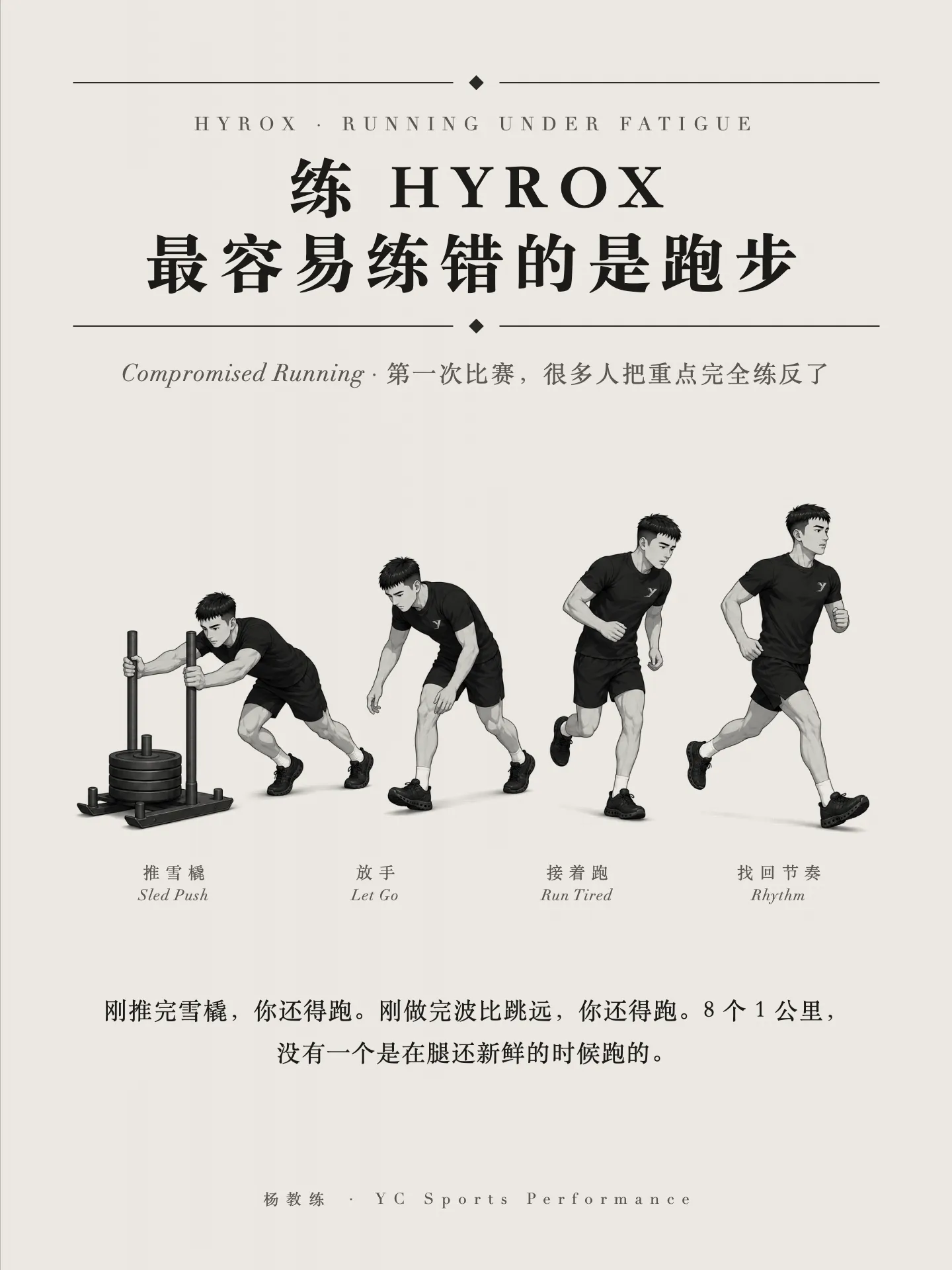





When people prepare for their first HYROX, the thinking is usually very direct: can't push the sled, so train more legs; can't get through the Wall Balls, so squat more; the race is exhausting, so do more HIIT. Two or three months later, every number in the gym has gone up, and they still fall apart on race day. Why?
Because HYROX is built as 8 runs of 1 km with 8 stations in between. You've just pushed the sled, and you still have to run; you've just done 80 m of burpee broad jumps, and you still have to run. Not one of those 8 km is run on fresh legs.
In 2025, the first study dedicated to HYROX had 11 amateur competitors race a simulated event. The whole race took 86 minutes: running made up 51 minutes, and the 8 stations added up to 33 minutes. For 80% of the time, heart rate was above 90% of maximum. The slowest segment was the 5th 1 km run, at 7.4 minutes, straight after the burpee broad jumps.
The same group was tested on five things. The better their aerobic capacity, the more endurance training they did each week and the lower their body fat, the faster they finished. Grip strength and weekly strength-training volume showed no relationship with performance. The researchers' own conclusion: compared with other functional fitness races, HYROX places moderate-to-low demands on maximal strength.
So a fast standalone 5 km doesn't mean a fast HYROX run. What you need is to find your running form and pace again after the sled, the lunges and the burpees. Across nearly 40,000 results from the Pro division, running consistently makes up half the race, and it has the strongest relationship with overall performance.
You definitely need to train strength: if it's too weak, you won't get through the stations. But it's not the first thing that holds you back.
But don't just do endless race simulations either. Running ability, base strength, station-specific work and the ability to transition when fatigued: build these four separately, then gradually combine them. Give running on tired legs its own session each week: push the sled then run 1 km, do burpees then run 1 km, so you're training how to run when your legs are heavy. Most people have never trained this session, and it's exactly where they lose pace in the race.
The biggest mistake isn't training too easy; it's training that isn't aimed at where you actually slow down in the race. For HYROX conditioning, don't just repeat all 8 race movements every day. Find your weak point first, then decide how to combine strength, running and stations.
Which of your 8 runs is the slowest? Tell me in the comments and I'll see which station you're getting stuck after.
Back to all daily posts