
YC SP.#027Badminton · 2026.10.13
Badminton: why you fall behind by the third shot when you're pushed deep again and again
The graphics in this post are in Chinese. The text below is an English translation.
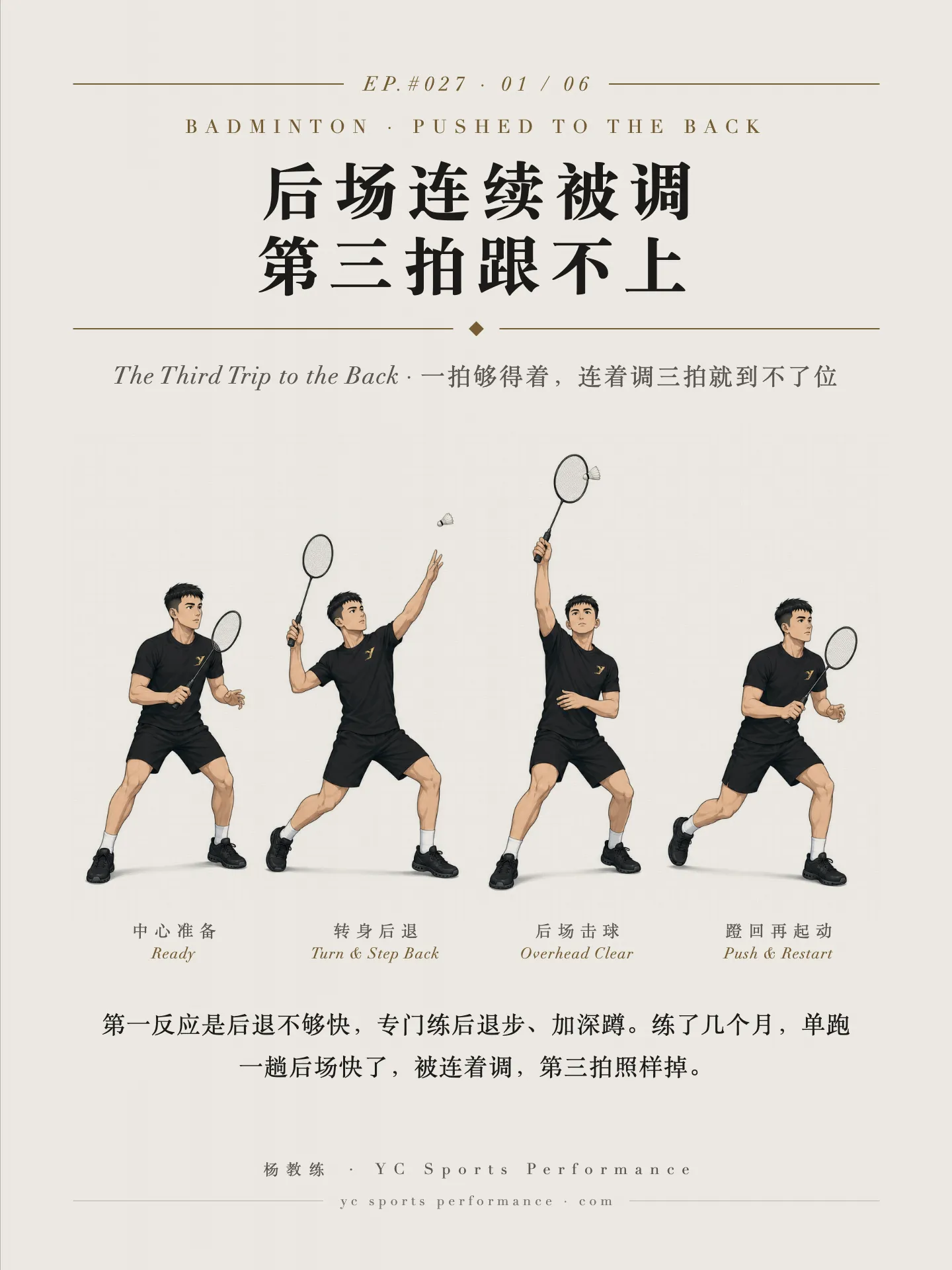



Plenty of badminton players know this: first you're pushed to the forehand rear corner and retreat to play a shot; then to the backhand rear corner, and you still reach it; then the third shot pushes you back again, and you just can't get there. The usual first reaction is that you're not quick enough moving backwards, so you work specifically on backward footwork and add squats. A few months later, a single run to the rear court is faster, but when you're moved around repeatedly, you still fall behind on the third shot. Why?
Because in a match there's no such thing as "a single run". Being moved three times in a row means three stops and three restarts, with two recoveries to base in between. This is where it breaks down: each start is slower than the last, and you can't recover between shots.
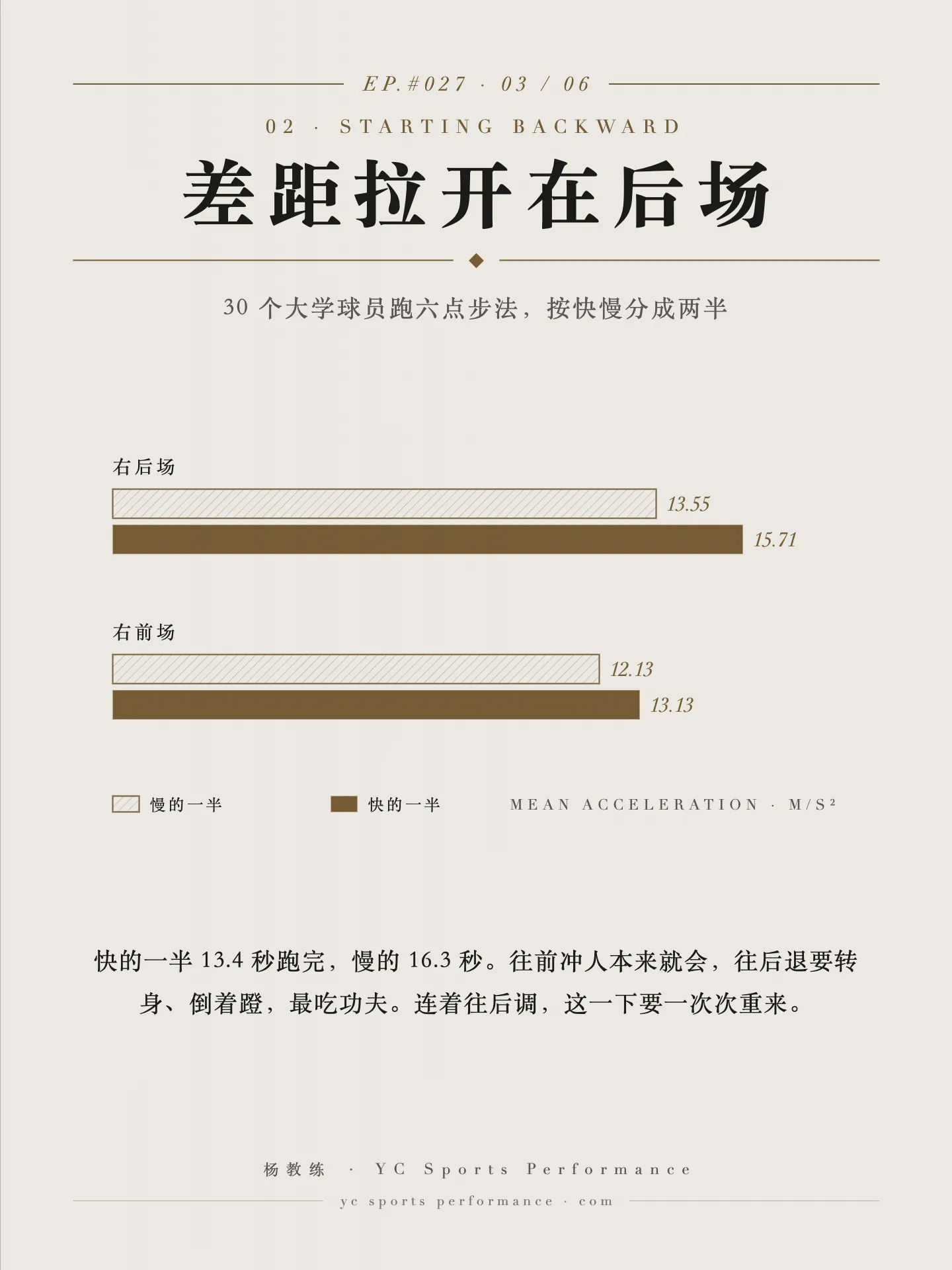
Reason one: starting backwards is the hardest part. In Taiwan, 30 university players ran a six-point footwork drill and were split into halves by speed: the faster half finished in 13.4 seconds, the slower in 16.3 seconds. On the run to the right rear corner, the faster group's acceleration and braking forces were 16% greater than the slower group's; to the right front corner, the difference between the groups wasn't statistically significant. Moving forward comes naturally; moving backwards means turning and pushing off in reverse, and when you're pushed back again and again, you have to do it from scratch every time.
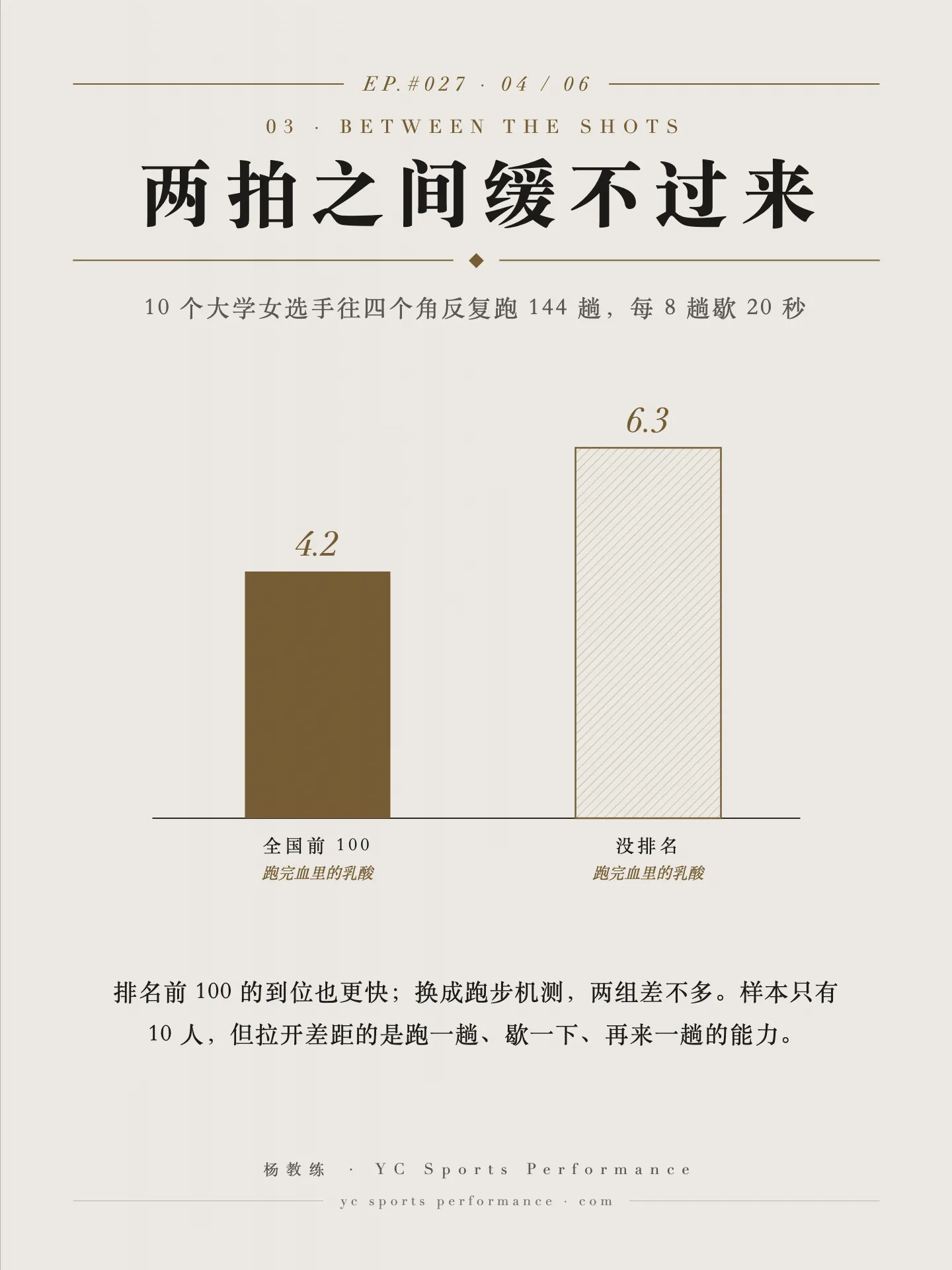
Reason two: you can't recover between shots. In Japan, 10 female university players ran repeatedly from the centre to the four corners, 144 times, resting 20 seconds after every 8. The 5 ranked in the national top 100 finished with blood lactate of 4.2, the other 5 at 6.3 – a third lower – and they also got into position faster; tested on a treadmill, the two groups were about the same. The sample is small, but the direction is clear: what separates players is the ability to run once, rest briefly and go again. In Germany, internationally ranked players were tested in simulated singles: rest between points was only 11.4 seconds, and average heart rate over the match was 89% of their maximum.
So what should you train? Four things.
Starting backwards: backward pogo hops, and jogging into a sudden stop followed by a backward run.
Rear-court back-and-forth: a partner points randomly to either rear corner – get there, swing, and immediately return to the centre before going again.
Recovering between efforts: 15 seconds all-out on a bike or ski erg, 45 seconds rest, 6 sets per round.
Play it point by point: 10 seconds all-out, 20 seconds walking, 15 rounds in a row.
If you only train how fast you can retreat once, you'll still fall behind on the third shot. This is key.
Are you slow moving back from the first shot, or do you only fall behind by the third? Tell me in the comments.
Back to all daily posts