
YC SP.#015Rowing · 2026.09.28
Rowing | Your legs are strong, so why doesn't the power reach the oar?
The graphics in this post are in Chinese. The text below is an English translation.
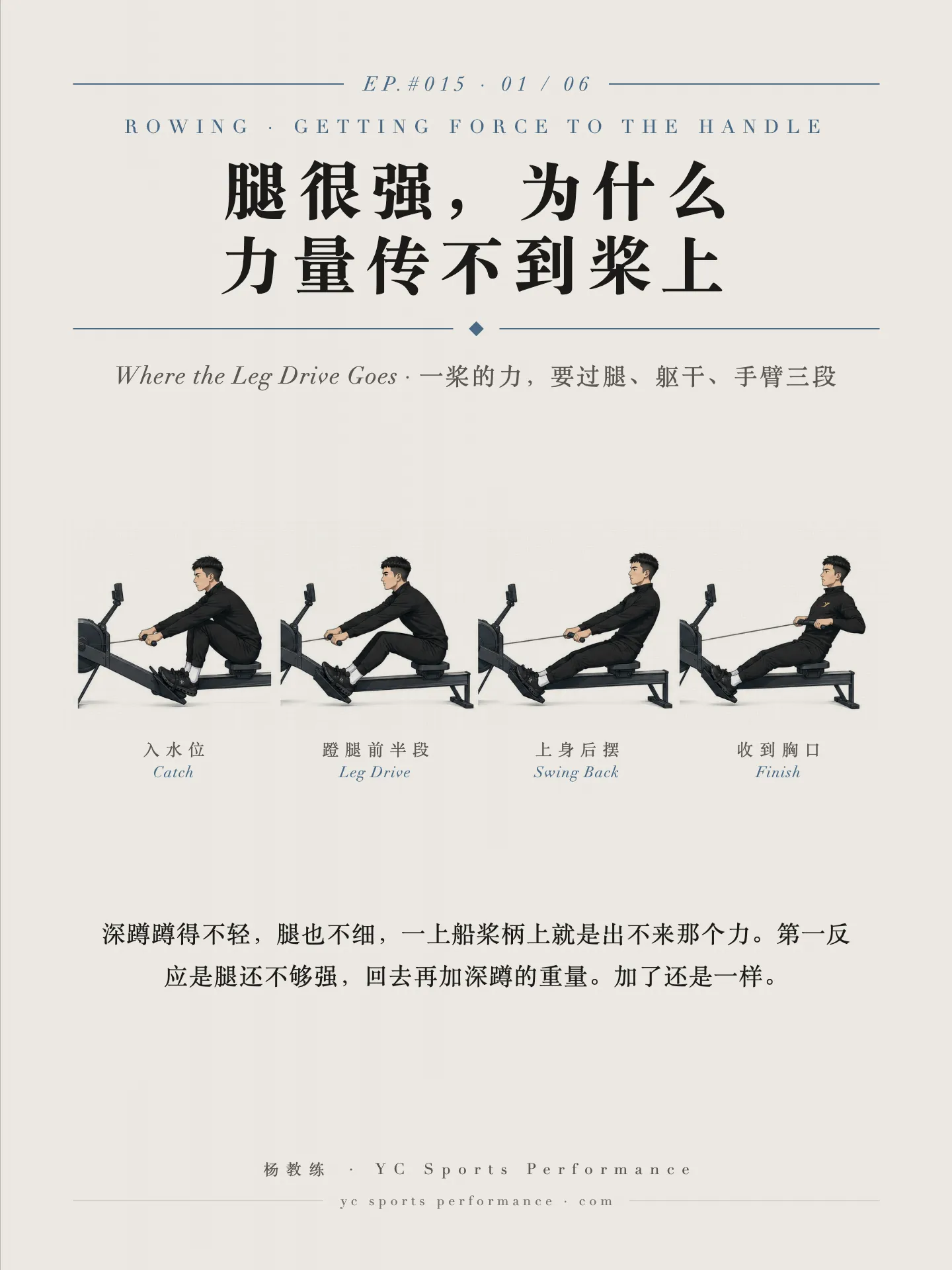





Plenty of rowers squat heavy and have solid legs, yet once they're in the boat, the force just doesn't show up at the handle. The first reaction is that the legs still aren't strong enough, so it's back to the gym to add weight to the squat. Even after adding it, nothing changes. Why?
First, look at how the force of a stroke gets out. One study used wireless sensors to measure 88 elite rowers on the water and split the power of each stroke across three body segments: legs 45.2%, trunk 32.2%, arms 22.6%. The legs are the biggest segment, but still only about 45%; the remaining 55% comes from the trunk and arms. The force your legs produce doesn't travel to the handle by itself – it has to pass through the pelvis and lower back, then the shoulders and arms. If any link in between is soft, however big the force before it, it won't get through.
From the same data: a rower on the water has only two points where force goes out. Of the power in a stroke, 52.8% goes through the handle and 47.2% through the foot stretcher. The nearly half at the foot stretcher pushes the boat directly – none of it is wasted. The question is why the 53% that should come through the handle doesn't arrive.
Reason one: the trunk moves along with the leg drive. If your upper body swings back with it, or your lower back collapses, the movement your legs produce is used up within your own body. In a test of 20 elite women rowers on a rowing machine fitted with an instrumented handle and instrumented foot stretchers, how the hips moved explained nearly half of the differences in foot force among the 20; how the knees and lumbopelvic region moved determined how much of that force was directed towards propelling the boat.
Reason two: the trunk can lock, but not for that long. When 13 national-level rowers rowed continuously for an hour, the range of spinal movement in each stroke clearly increased. In a single test of 16 high school rowers, the lower back flexed more and more as they rowed, the three muscles running along the spine worked harder and harder, and their electrical signals showed they were fatiguing.
Strength still needs training. In a 2011 review, maximum leg press load and maximum leg extension force were both related to 2000 m performance. But the same review also noted that there are still too few long-term controlled studies on whether strength training actually improves performance, so the improvements seen so far can't be taken as conclusive.
Train four things. A trunk that stays locked: boat holds, planks with leg lifts and side planks, building from 45 to 60 seconds. Hip hinge: deadlifts and single-leg deadlifts, back flat the whole way – if your back rounds, drop the weight. Keep training maximum leg strength: squats and box squats. Practise the sequence on its own: slow, low-rate rowing – drive the legs fully, then swing the upper body back, and draw the arms into the chest last.
If the force isn't showing up at the handle, don't add squat weight yet. First check the leg drive: is your upper body locked, or is it swinging back along with it?
When you row, does your upper body stay still through the leg-drive half of the stroke, or does it move back with it? Tell me in the comments.
Back to all daily posts