
YC SP.#014Climbing · 2026.09.26
Falling short on climbing dynos: what's missing may not be your arms
The graphics in this post are in Chinese. The text below is an English translation.




Many boulderers have run into this: there's a dyno on a problem where you have to drive up, leave the wall and catch the hold above, and after a dozen attempts you're still a few centimetres short. Back on the ground, the first reaction is that your arms don't pull hard enough, so you go back to pull-ups and the fingerboard, and a month later you still can't reach it.
Researchers have measured the forces in a dyno directly. 7 French climbers who climb 7c and above did dynos on an instrumented wall, with a three-axis force sensor under each hand and each foot, three attempts each.
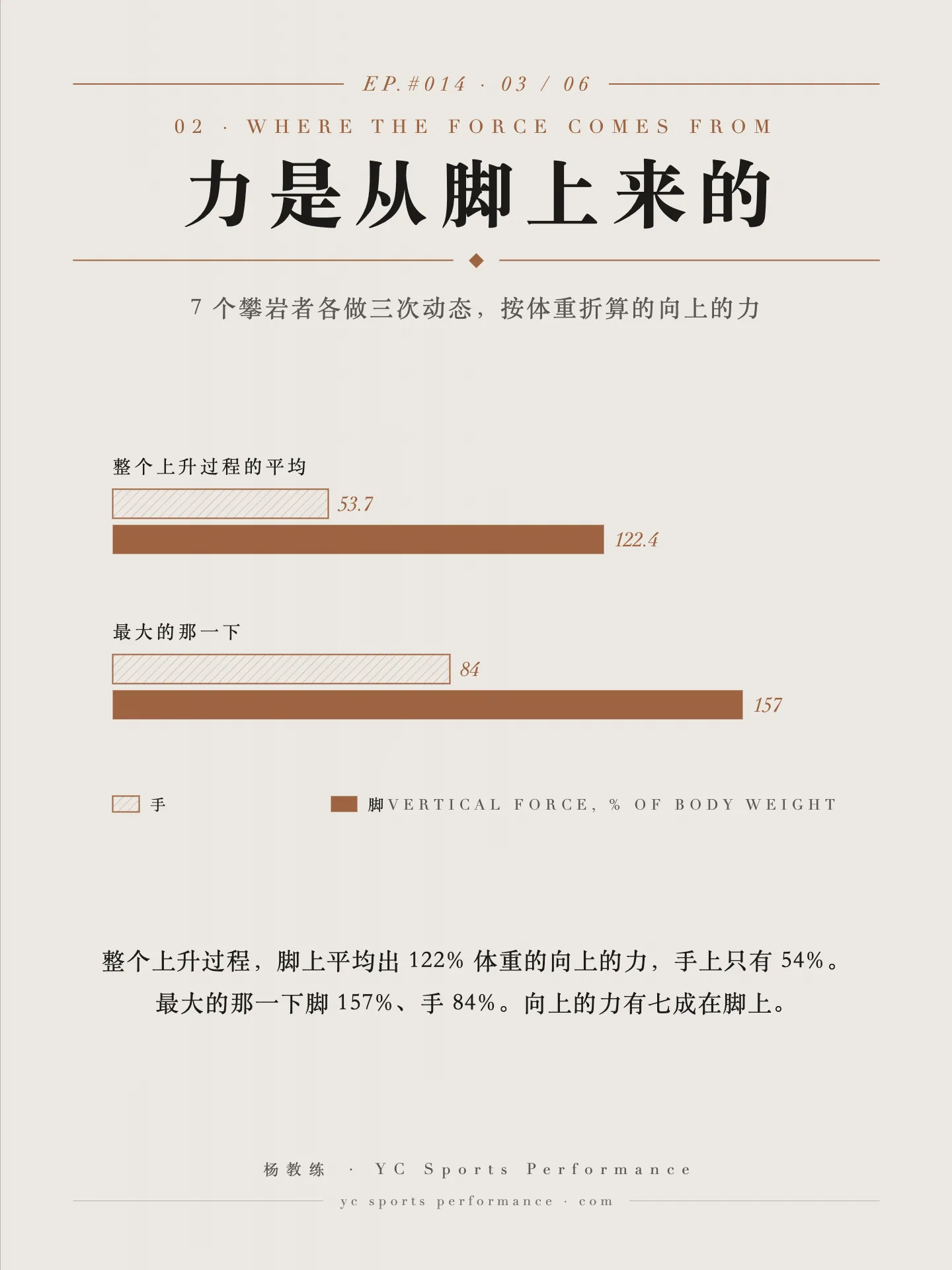
First, where the force comes from. Across the whole upward phase, the feet produced an average upward force of 122% of body weight, while the hands produced only 54%, so the feet did more than twice as much as the hands. At peak, the feet pushed 157% of body weight and the hands only 84%. 70% of the upward force came from the feet. The hands were doing something else: pulling the body in towards the wall, at up to 66% of body weight, to counter the recoil from the feet pushing out.
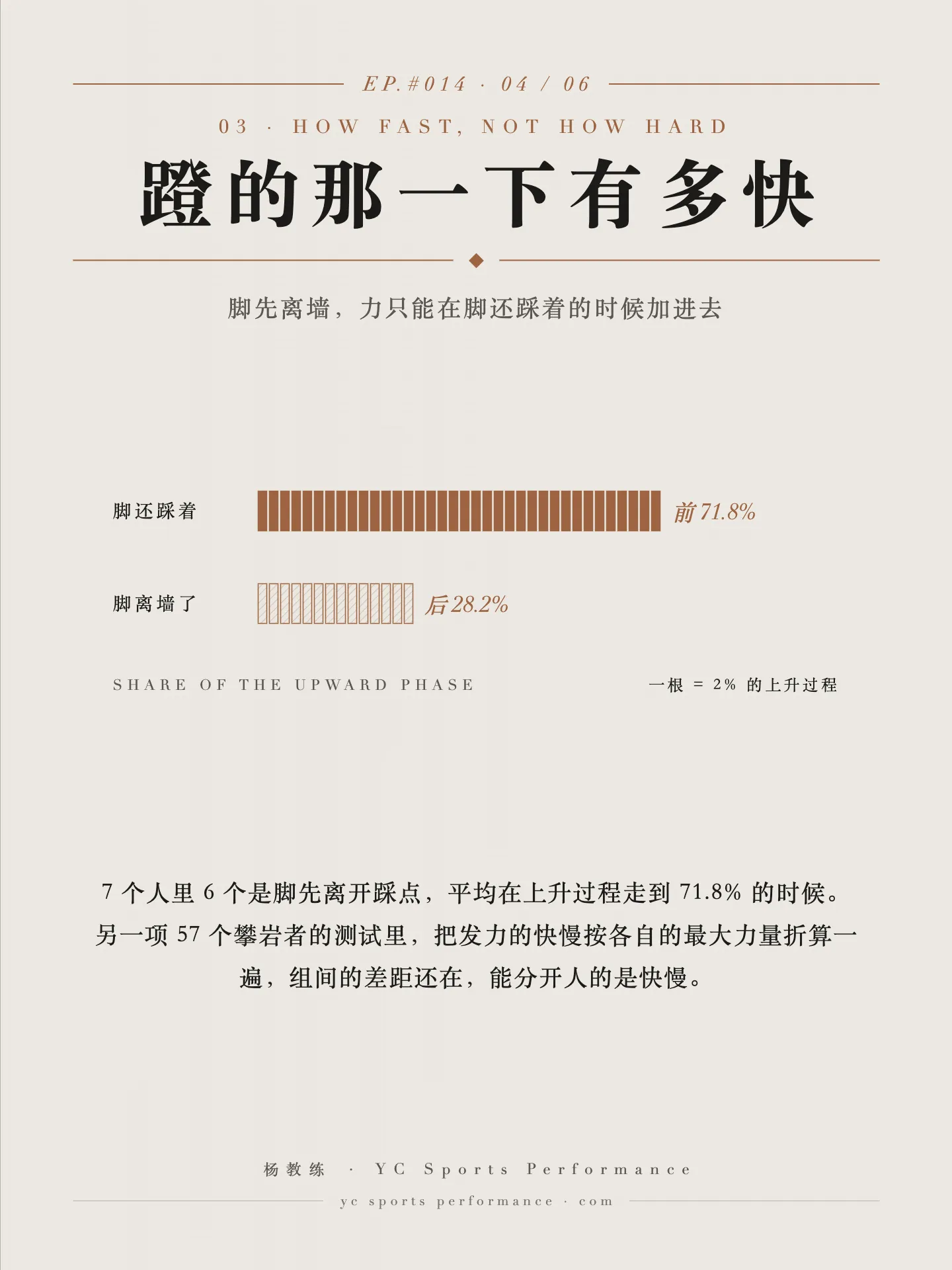
One more detail. In 6 of the 7 climbers, the feet left the footholds first, on average 71.8% of the way through the upward phase. Once your feet leave the wall, you can't add any more force, so the moment you feel your "hand didn't make it" was actually decided while your feet were still on.
The second reason is speed. 57 male climbers split into three groups did isometric pull-ups on a 23 mm edge. The elite group did have higher maximal strength, but what separated people more was rate of force development: how much force they produced in the first 50, 100 and 150 ms after starting to pull was clearly higher in the elite group at every point. Even after scaling rate of force development to each climber's own maximal strength, the gap between groups remained.
In a dyno, you can only apply force in the fraction of a second while you're pushing off the holds. Once your hands and feet leave the wall, you can't add any more. How much you can squat isn't the point – the point is how much force your legs can produce in that fraction of a second.
For conditioning, train four things. First, jumping and pushing off fast: squat jumps, box jumps and loaded jumps – low reps, full rest, every rep as fast as possible. Second, the hips: how high you go is how far your hips travel upward. Third, ankles and footwork: on boulder problems you stand on footholds just a few centimetres wide, and if your ankle can't hold, force leaks out through your foot. Fourth, fast hands: on the fingerboard, do short, sharp catches and dynamic pulls, not just long dead hangs.
One caveat: in a study testing 24 recreational climbers, lower-body strength and jumping showed no direct link with how hard they could climb. So this post is only about one move: the dyno you can't reach.
That dyno you can't reach – is it that your push-off doesn't get you high enough, or you get the height but can't hold on? Tell me in the comments.
Back to all daily posts