
YC SP.#013Golf · 2026.09.28
Golf swing speed won't go up: which physical qualities should you train?
The graphics in this post are in Chinese. The text below is an English translation.
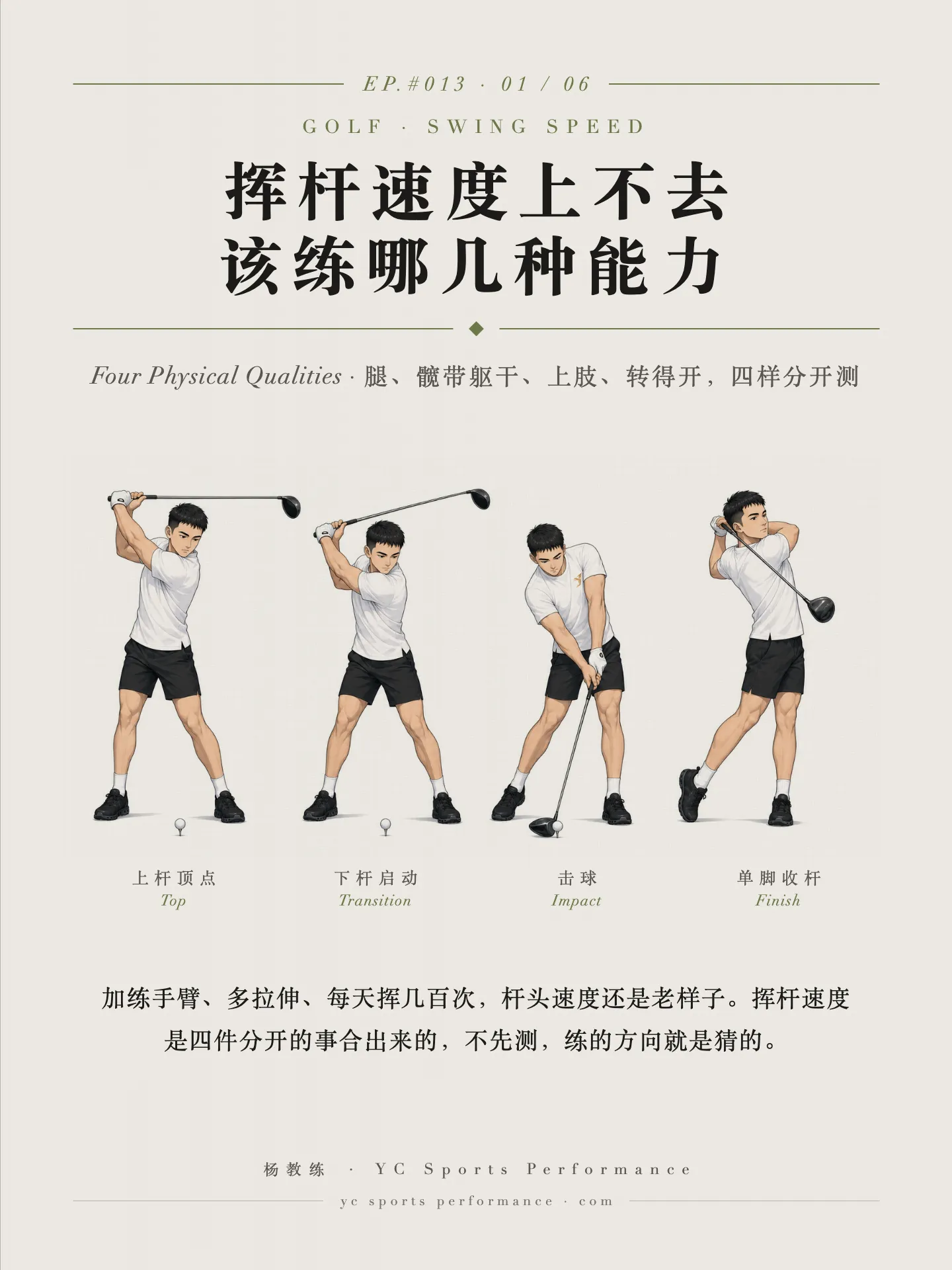


Swing speed is the result of four separate things combined: how hard your legs push into the ground, how powerfully your hips drive trunk rotation, how fast your upper body pushes, and whether your thoracic spine and hips can rotate freely. If you don't test them separately first, the direction of your extra training is just a guess.
First: which of these four holds you back most depends on your current level.
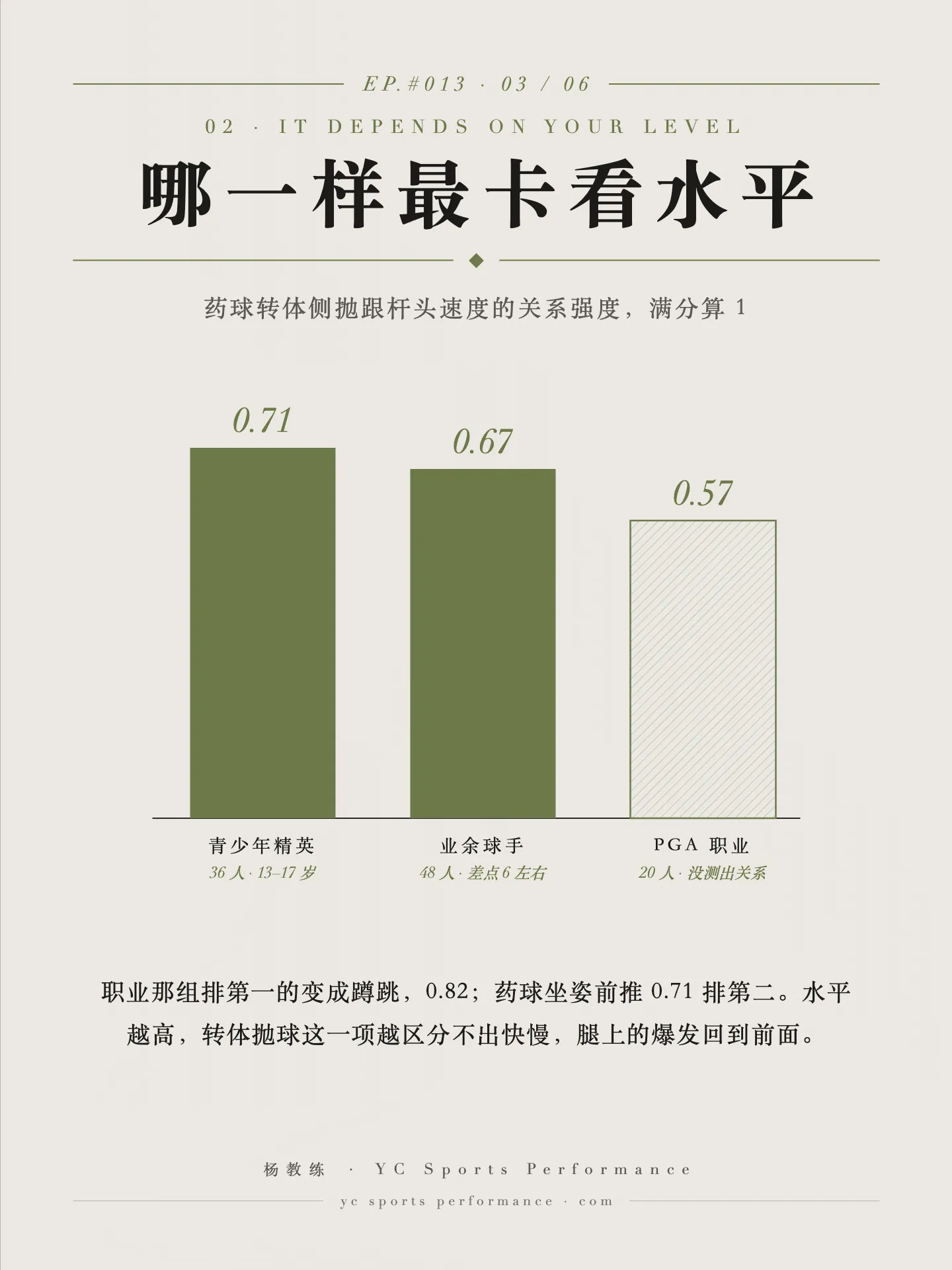
In 36 elite junior golfers aged 13 to 17, the measure most strongly related to driver clubhead speed was the rotational medicine ball side throw, at 0.71 (on a scale where 1 is the strongest relationship). In 48 amateur golfers with a handicap of around 6, the rotational side throw was again top, at 0.67. But in 20 PGA professionals, the rotational side throw was only 0.57, and no relationship was found for this measure; the top spot went to the squat jump at 0.82, with the seated medicine ball chest throw second at 0.71. So the advice to "train more rotation" is right for juniors and amateurs, but not necessarily for professionals. The largest group across the three studies had only 48 people, so treat this as a direction only.
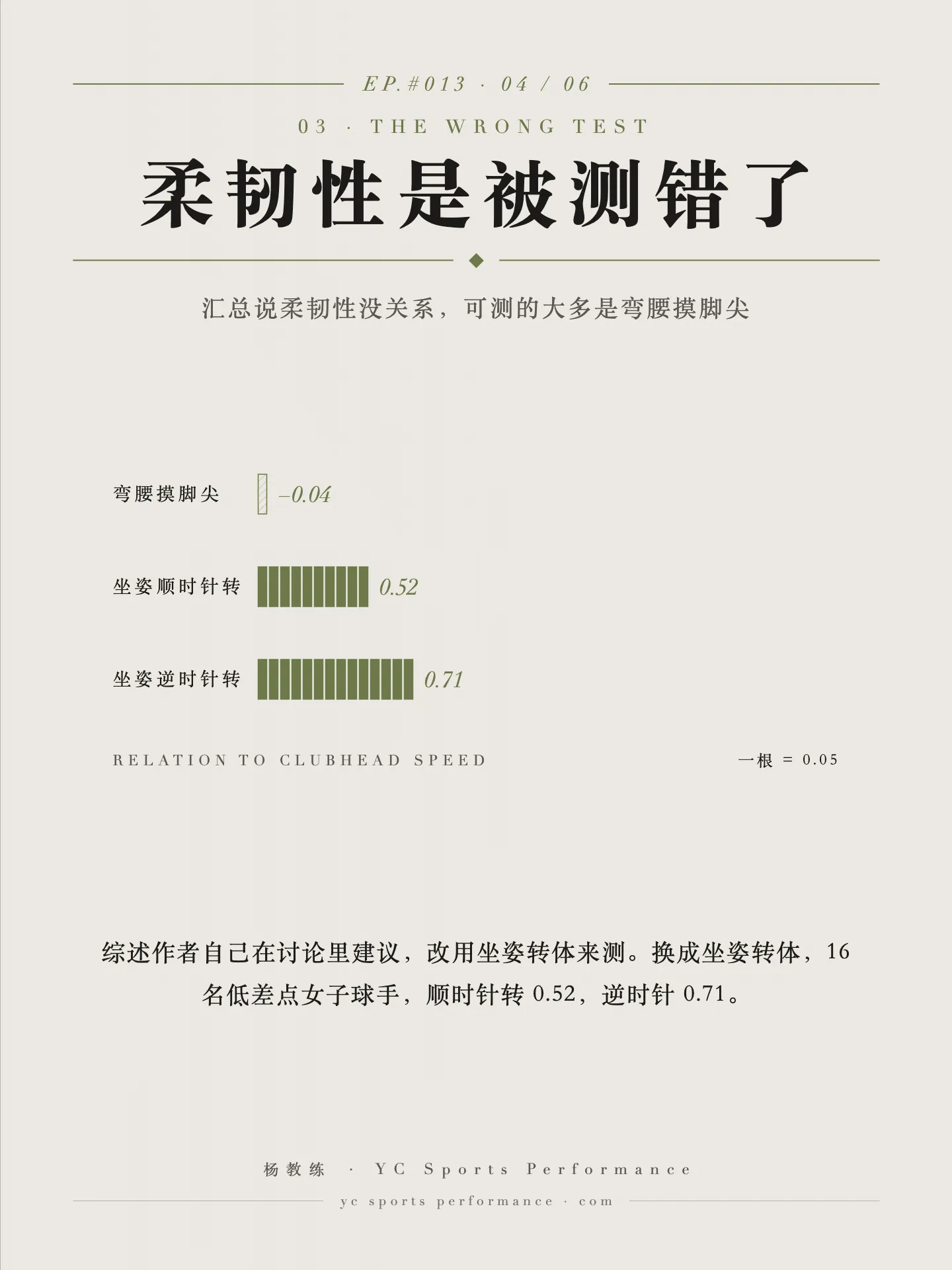
Second: rotating freely. People in golf say flexibility has nothing to do with hitting it far, and that claim has a source: pooling 20 studies, the relationship between flexibility and clubhead speed was almost 0. But open the original papers and most of them measured the seated sit-and-reach, bending forward to touch your toes, a movement with little to do with the swing. The review authors themselves suggested in their discussion switching to a seated rotation test. With seated rotation, in 16 low-handicap female golfers, the relationship was 0.52 rotating clockwise and 0.71 anticlockwise.
Here's the order I give for structuring the conditioning.
One: lower-body power into the ground. Squats and deadlifts as the base, then kettlebell swings, squat jumps and lateral push-offs.
Two: hip-driven trunk rotational power. Medicine ball wall throws and side throws, always starting from half-kneeling, split-kneeling or split stance; turn the hips first, then the upper body, and the lower back must not actively twist.
Three: upper-body pushing power. Seated medicine ball chest throws and single-arm shot put-style throws.
Four: rotating freely. 90-90 hip rotations, split-stance thoracic rotations and quadruped thoracic T rotations, in every session.
And one more that's most easily missed: being able to brake, holding a stable finish.
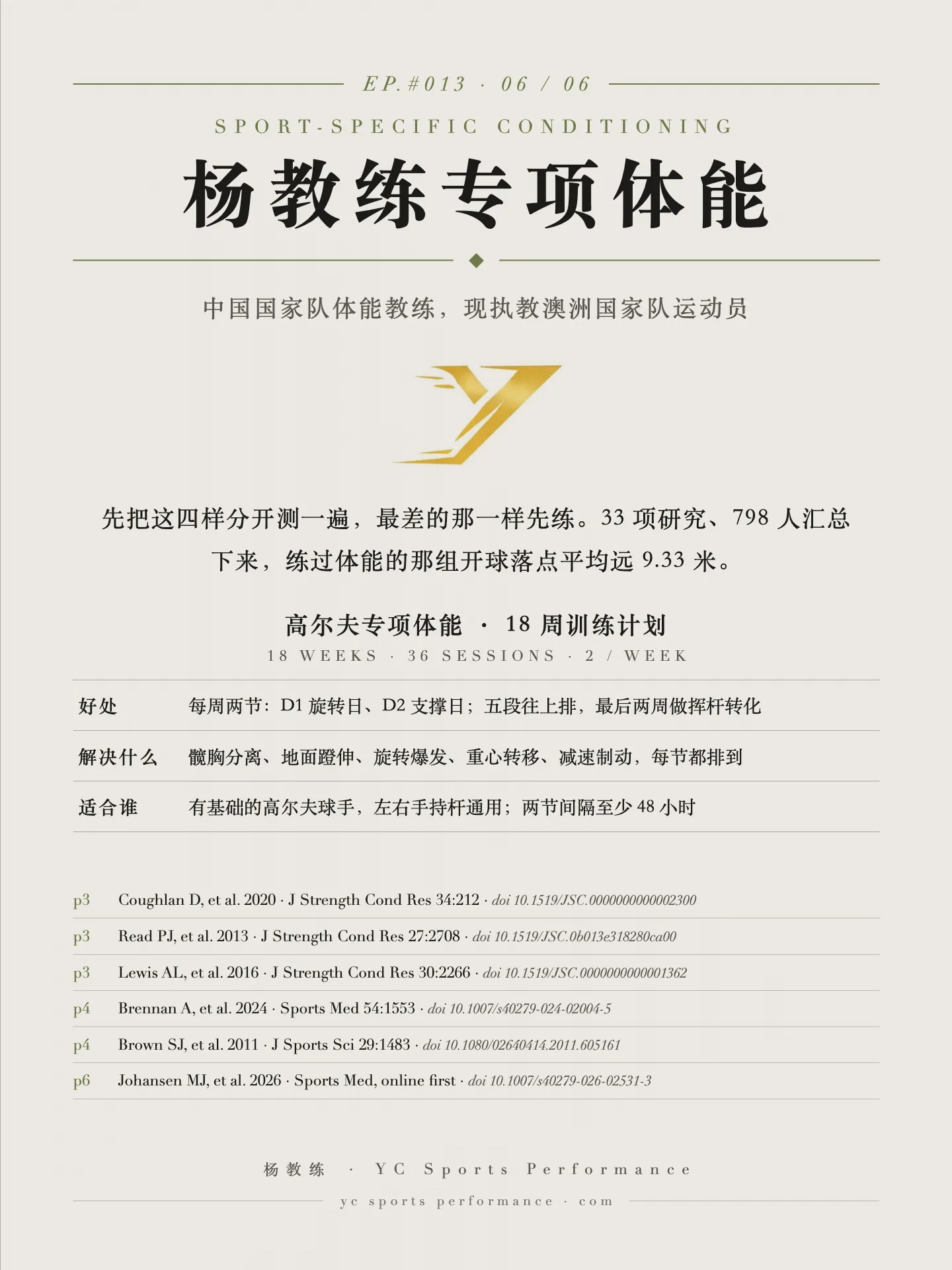
A 2026 analysis pooling 33 studies and 798 people: the groups that did strength and conditioning had clubhead speed 1.05 m/s faster on average, and their drives landed 9.33 m further on average. The authors also noted that the overall quality of these studies is low, so treat the numbers as a reference.
Which of these four are you least sure about? Tell me in the comments.
Back to all daily posts