
YC SP.#012Baseball · 2026.09.27
Bat speed won't go up: should you still train upper-body strength?
The graphics in this post are in Chinese. The text below is an English translation.
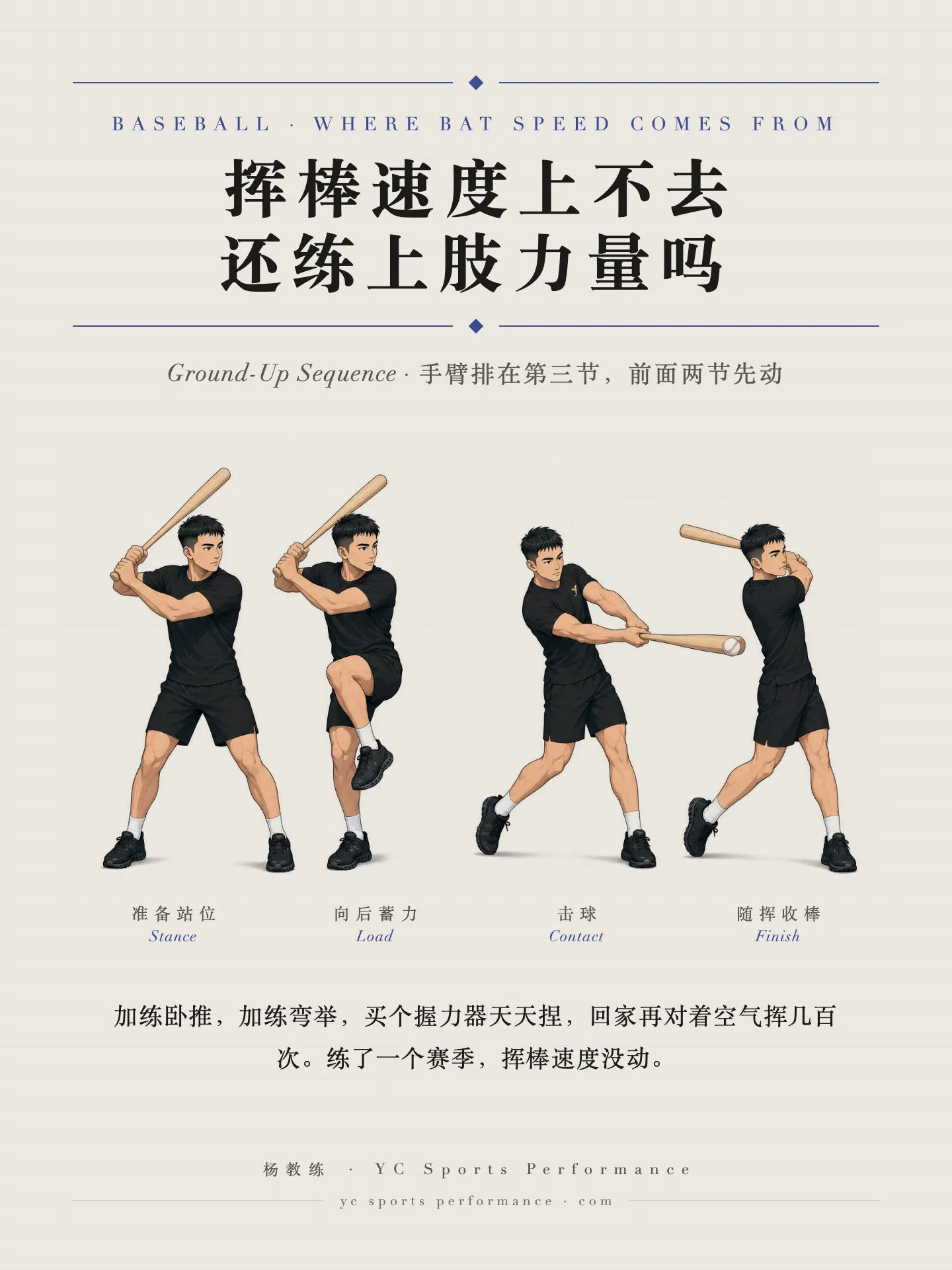



Many hitters who want to hit the ball further think of the upper body first: extra bench press, extra curls, a grip trainer to squeeze every day, and a few hundred dry swings at home. After a season, bat speed hasn't moved. Why?
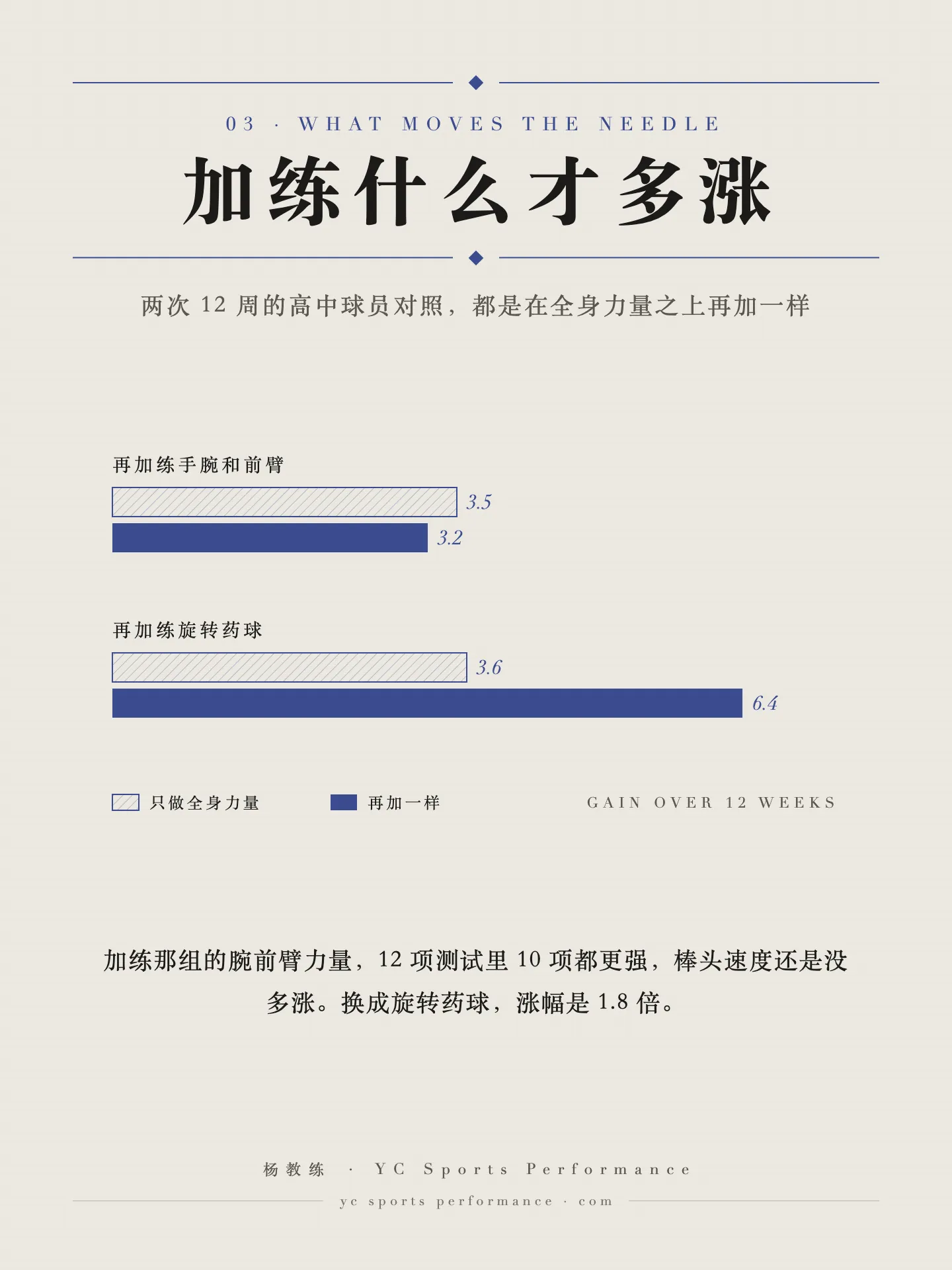
Researchers have compared two groups. 43 high school players, 12 weeks, both groups doing the same full-body strength program, with one group adding extra wrist and forearm training. The group with the extra work was stronger in 10 of 12 wrist and forearm tests. But bat speed: the full-body-only group improved 3.5%, the extra wrist-and-forearm group 3.2%, no difference between groups. It's been tested at university level too: 23 players, 6 weeks of extra forearm and grip training; both groups improved, with no difference between them.
Upper-body strength isn't useless, of course. Among 30 Japanese high school players, 14 had home runs on record in official games and 16 were regular hitters. Bench press relative to body weight was identical in both groups, 1.24 times body weight. On a scale where 1 is the strongest relationship: in the regular hitters, bench press was still related to bat speed at 0.62; in the home-run hitters, it was −0.01. When you're weak, strength holds you back; once you've trained to a certain level, it no longer does.
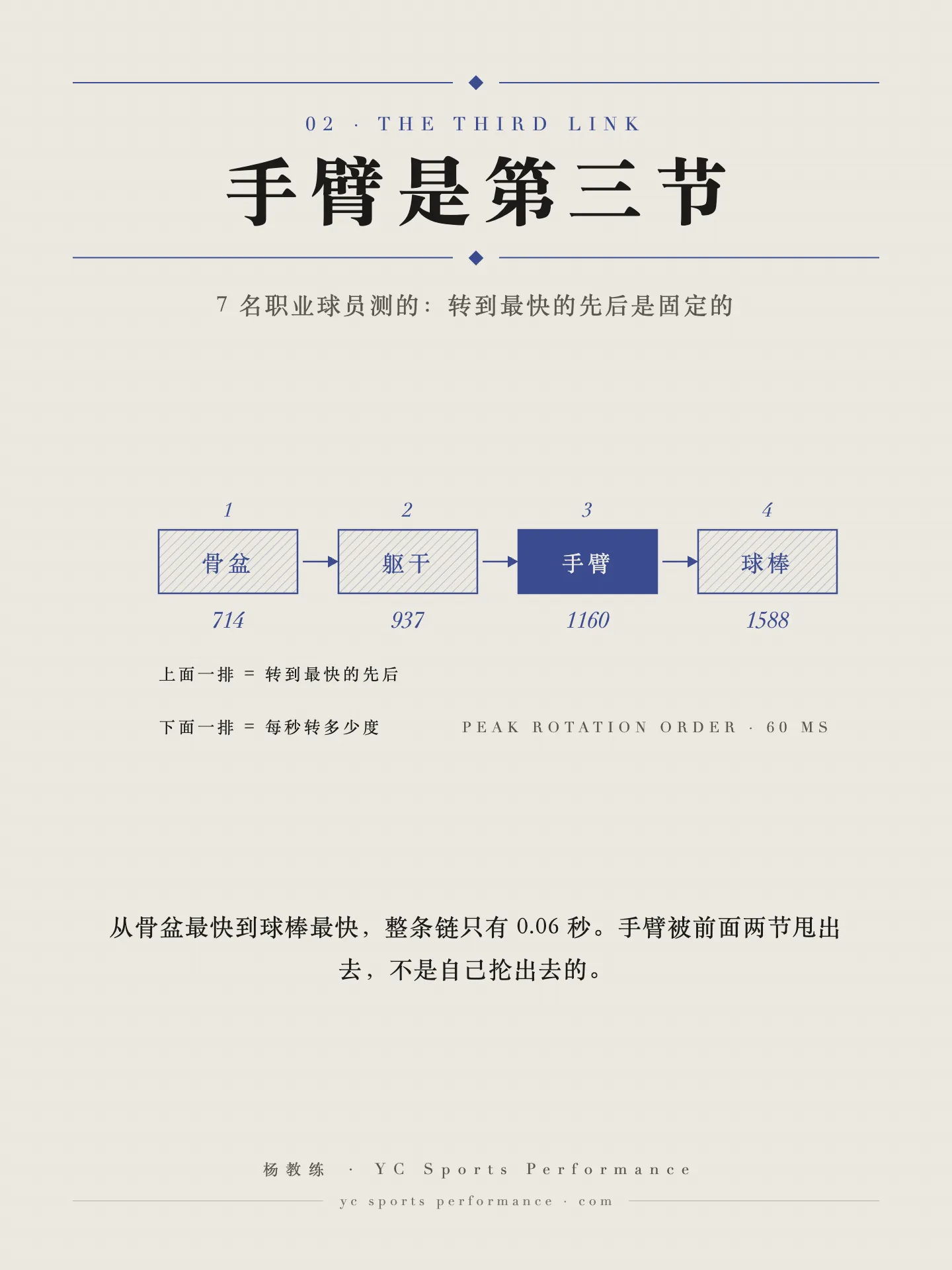
So what drives bat speed? The ground and the sequence. In 20 university players, after the front foot landed, the peak force it pressed into the ground reached 1.6 times body weight, while the back foot reached only 0.7 times; the harder the front foot pressed, the faster the swing, a relationship of 0.62, with no relationship found for the back foot. In professional players, the order in which each segment reaches peak rotation speed is fixed: pelvis 714 degrees per second, trunk 937, arms 1160, bat 1588, and the whole chain takes only 0.06 s. The arms are the third link.
So what should you train? One: drive the front leg into the ground: squats and deadlifts as the base, then add dropping off a box and jumping straight back up. Two: hip-driven trunk rotation: medicine ball side throws, rotational throws and wall slams. Three: sequencing: with a light bat or in slow motion, turn the hips first, then the trunk, with the arms coming last. Four: upper-body strength, placed last.
There are numbers on rotation. 49 high school players, 12 weeks, both groups doing a full strength program plus 300 swings a week, with one group adding four rotational medicine ball exercises. Bat speed: up 3.6% without them, up 6.4% with them, 1.8 times the gain.
Which link are you training right now? Tell me your bat speed and how you train in the comments.
Back to all daily posts