YC SP.#011Archery · 2026.09.24
Why your arrows are still inconsistent when you can draw the bow just fine
The graphics in this post are in Chinese. The text below is an English translation.
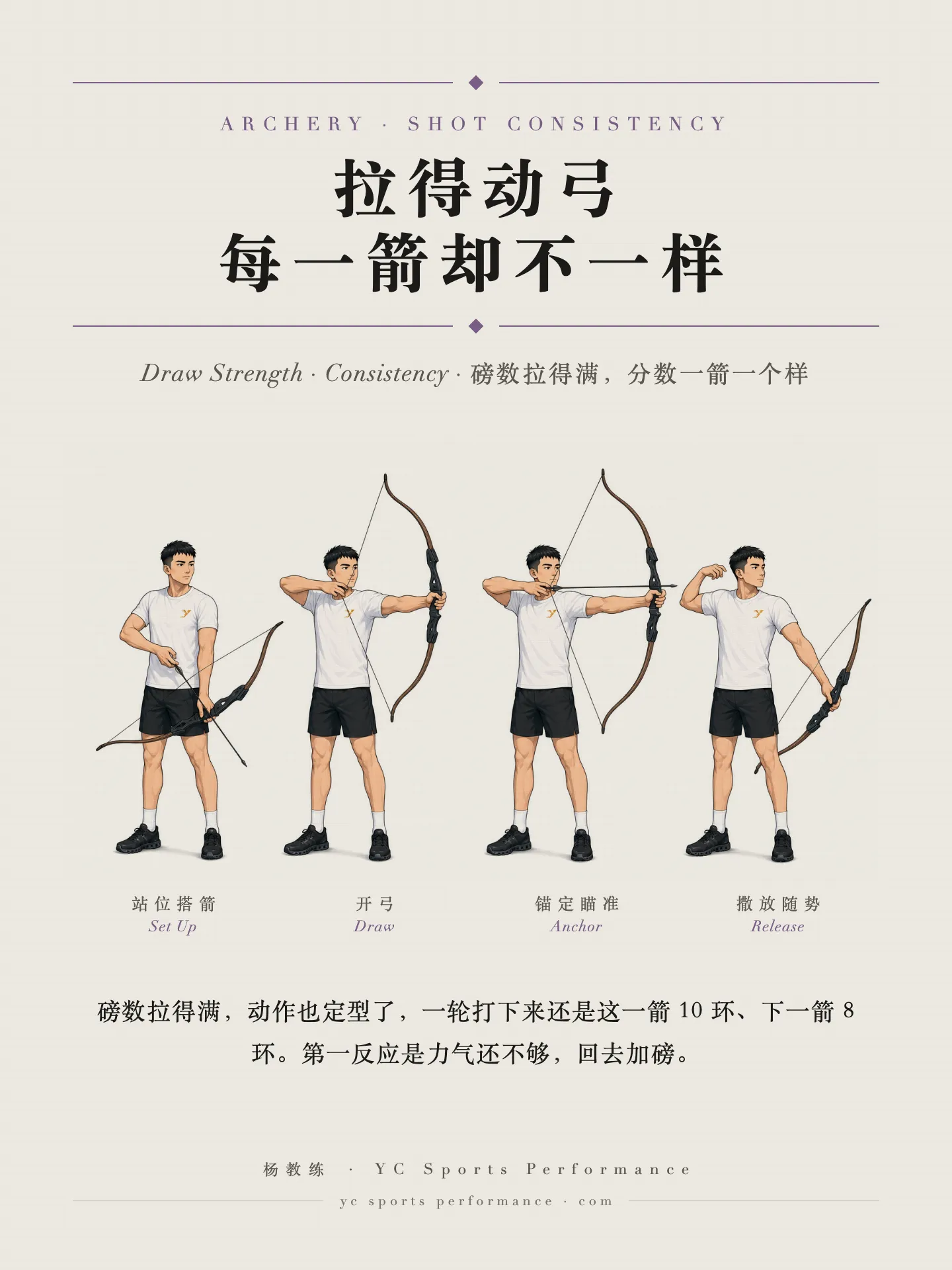
Many archers know this: you've long been able to draw your full poundage and your form is settled, yet over a round your scores vary from arrow to arrow. The first reaction is not enough strength, so you go back to adding poundage and training your arms. But with more poundage and stronger arms, why are you still inconsistent?
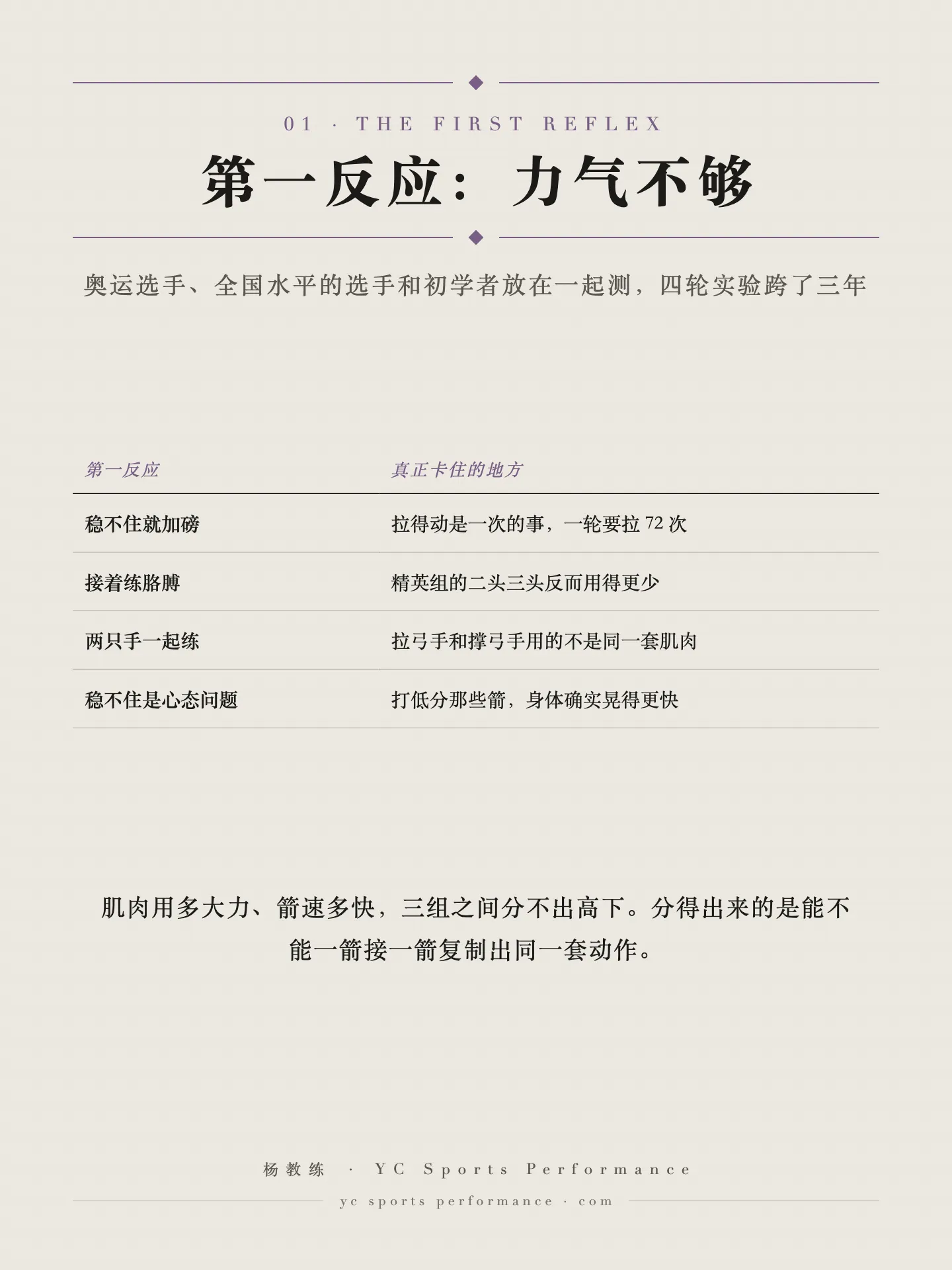
More than thirty years ago, Olympic archers, national-level archers and novices were tested together. How much force the muscles used and how fast the arrow flew didn't separate the three groups; what did separate them was whether they could reproduce the same movement arrow after arrow. Another study split 30 archers into three groups: the elite group's lower trapezius was clearly more active, while they actually used their biceps and triceps less. What holds the shot steady is the scapula, not the arm.
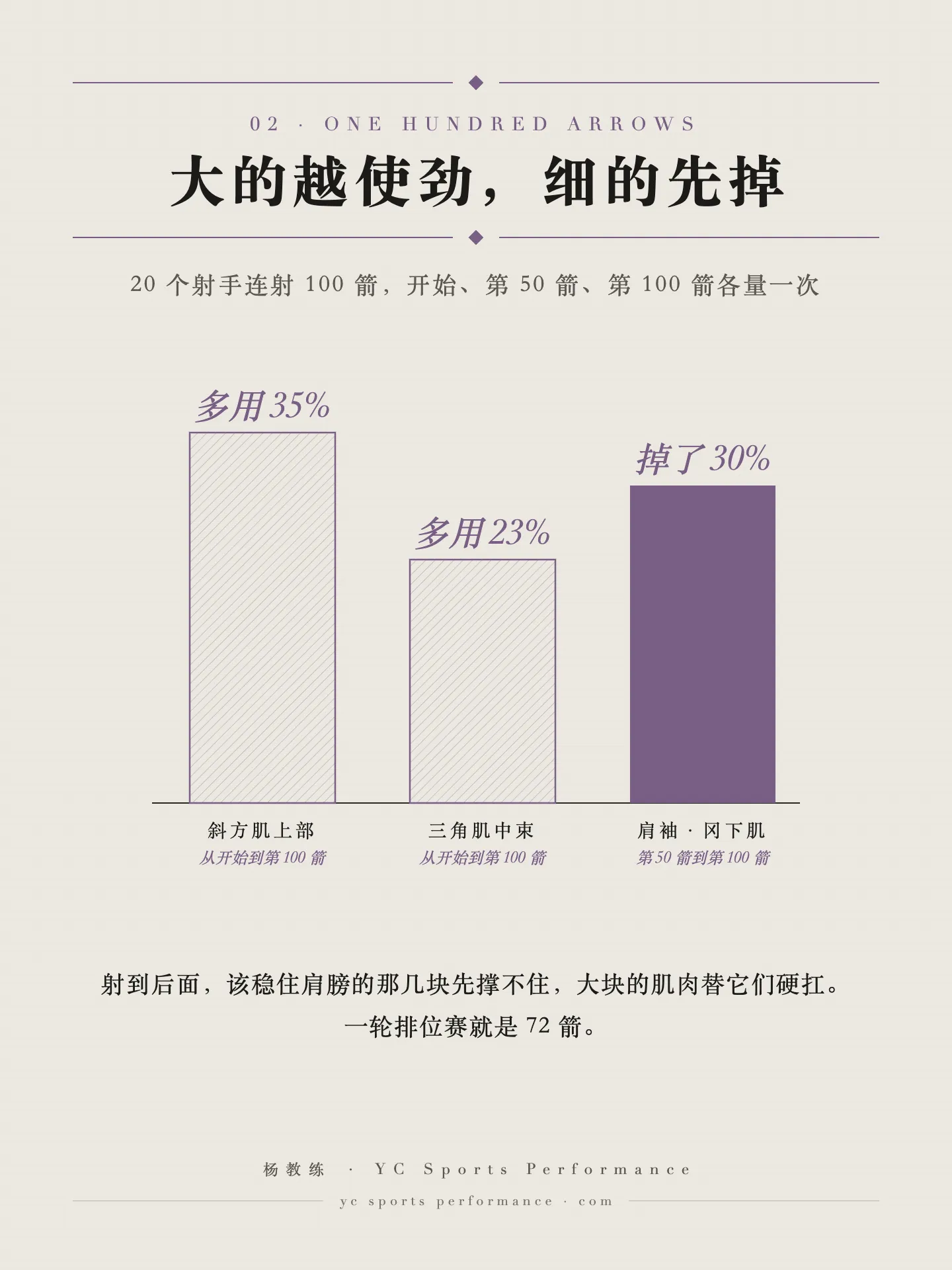
Researchers have measured why groups spread wider the more you shoot. 20 archers shot 100 arrows in a row, measured at the start, at arrow 50 and at arrow 100. The big muscles worked harder and harder: upper trapezius use rose 35% and middle deltoid 23%. The small muscles that hold the shoulder in place went the other way: infraspinatus, part of the rotator cuff, dropped 30% from arrow 50 to arrow 100, and lower trapezius, at the lower part of the shoulder blade, followed the same trend. A single ranking round is 72 arrows.
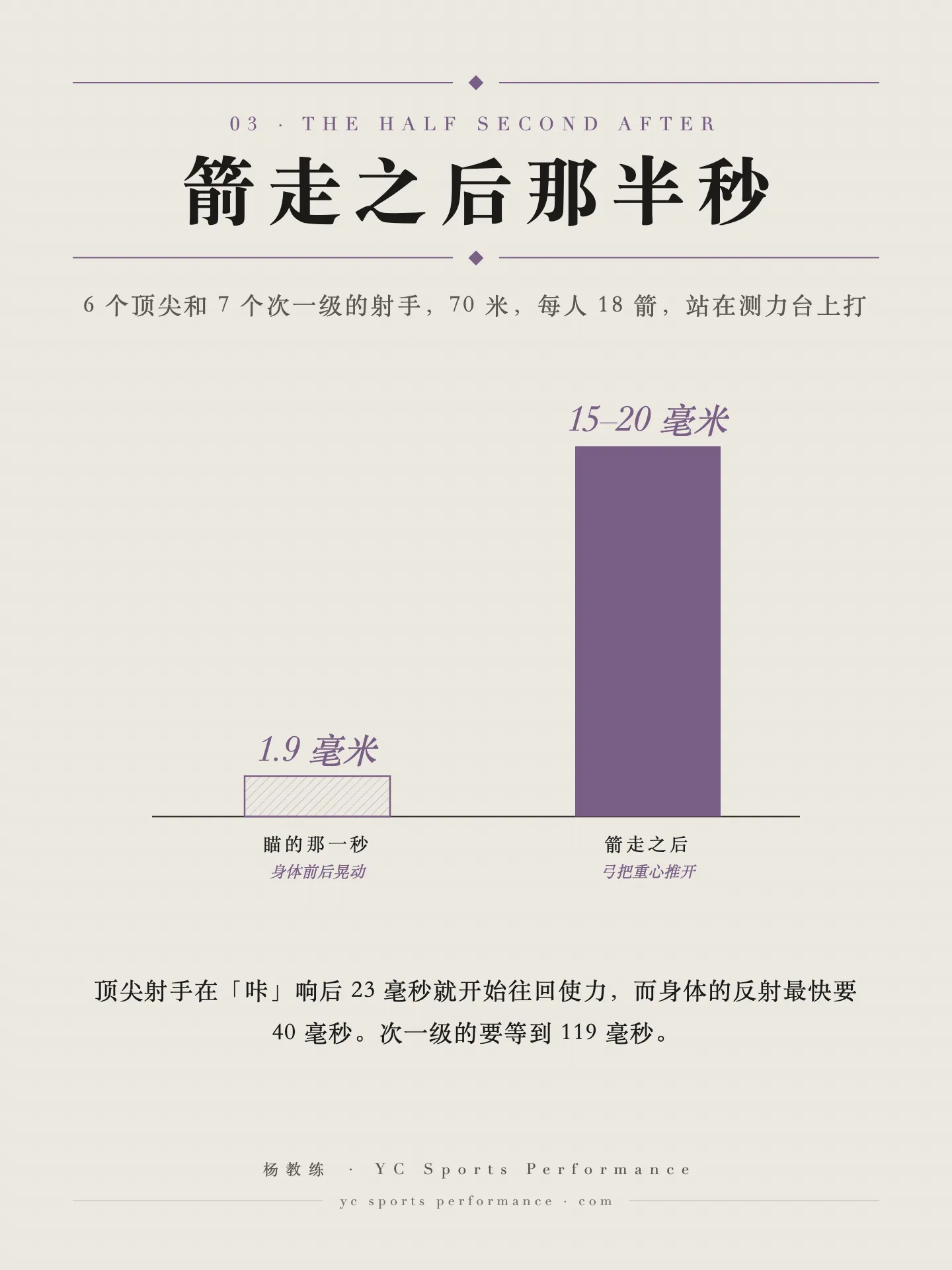
Now look at the shot itself. Six top archers and seven a level below shot 18 arrows each at 70 m. In the second of aiming, the body swayed only 0.7 to 0.9 mm; as soon as the arrow left the string, the bow's recoil pushed the centre of mass 15 to 20 mm, 8 to 10 times the sway while aiming. The top archers started pushing back 23 ms after the clicker went "click", while the body's fastest reflex takes 40 ms; in other words, they were ready before they were pushed.
There's plenty of variation within the same archer too. Eight archers ranked in France's top twenty, 549 arrows split into three bands by score: on the low-scoring arrows, the centre of mass moved faster during aiming, and the rear deltoid and middle trapezius on the draw side actually worked harder.
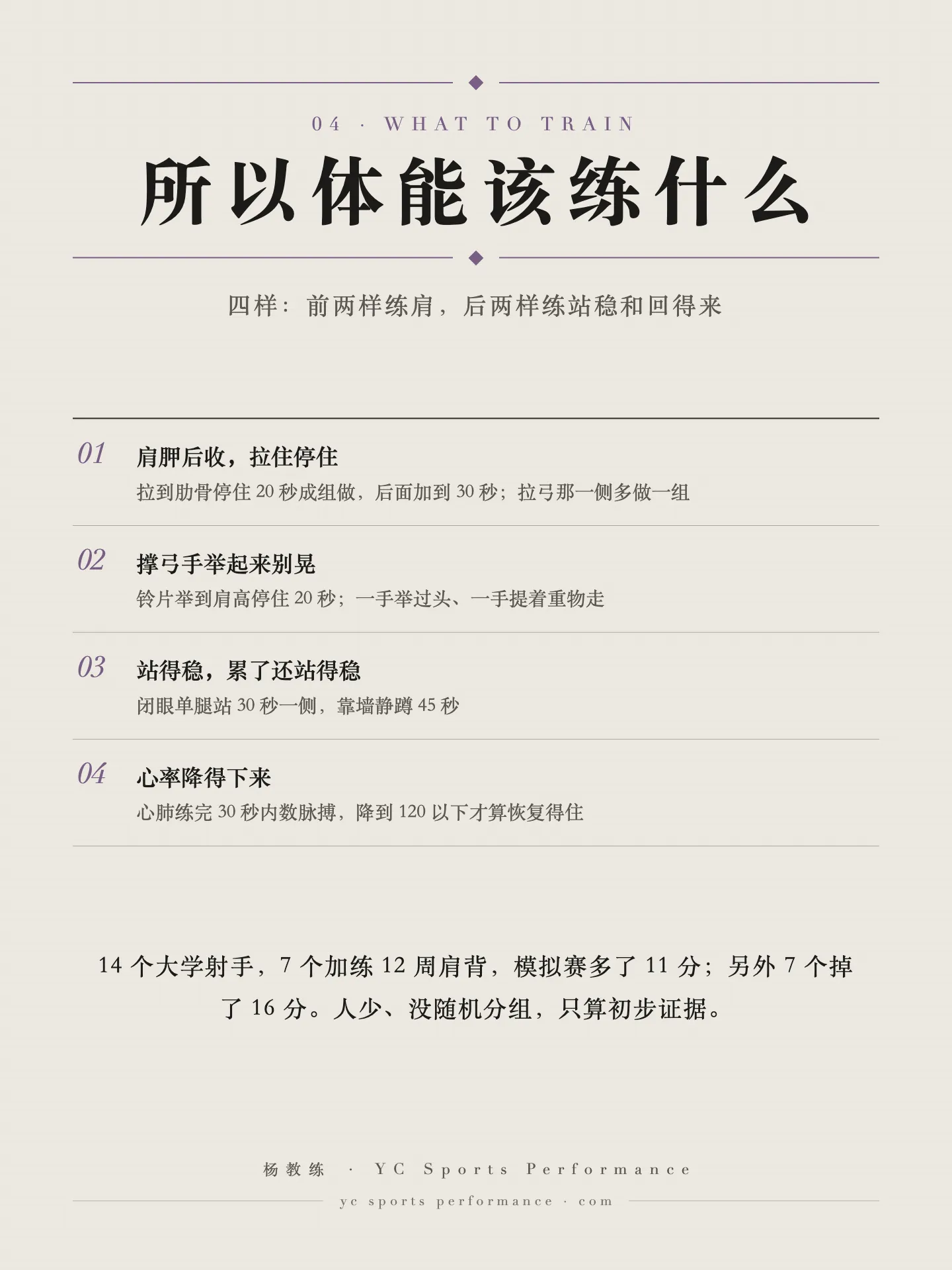
Train four things. First, scapular retraction that holds: pull to the ribs and hold for 20 s, in sets, building up to 30 s, with an extra set on the drawing side. Second, keep the bow arm from shaking when raised: lift a weight plate to shoulder height and hold for 20 s. Third, stand steady: eyes-closed single-leg stand for 30 s each side, and a wall sit for 45 s. Fourth, bring your heart rate down: count your pulse within 30 s of finishing cardio work, aiming to get it below 120.
Does training the shoulders and back help? Researchers have tried it. 14 university archers were split into two groups: 7 added 12 weeks of training focused on the lower scapular muscles and scored 11 points more in a simulated competition; the other 7 dropped 16 points. Small numbers and no random allocation, so it only counts as preliminary evidence.
The order is: first build a scapula that holds and a stable stance, then think about adding poundage.
In a 72-arrow round, from which arrow do your groups start to spread? Tell me in the comments.
Back to all daily posts