
YC SP.#010Handball · 2026.09.25
Why your handball jump shot goes soft late in the game, even when you have the power
The graphics in this post are in Chinese. The text below is an English translation.
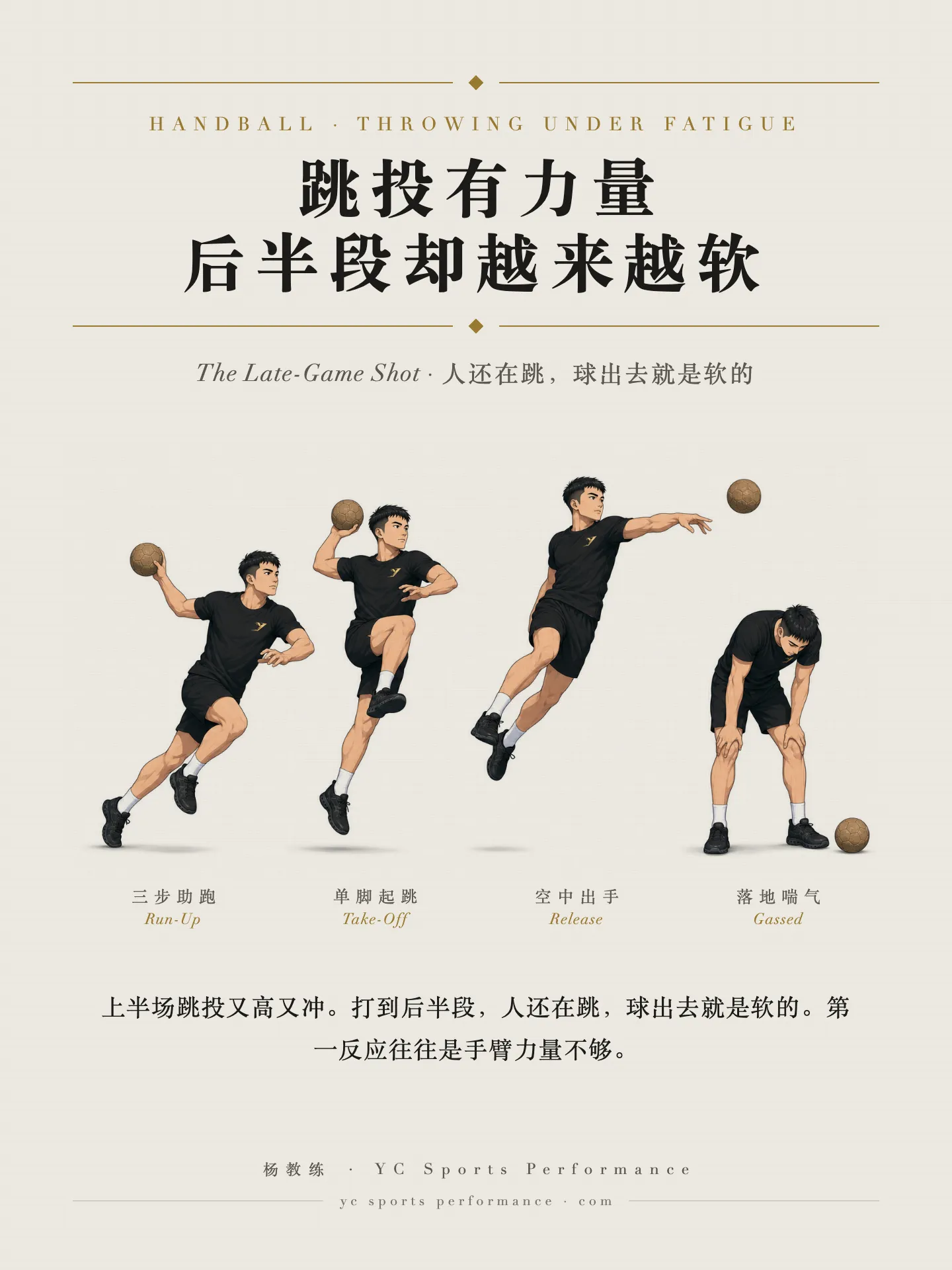
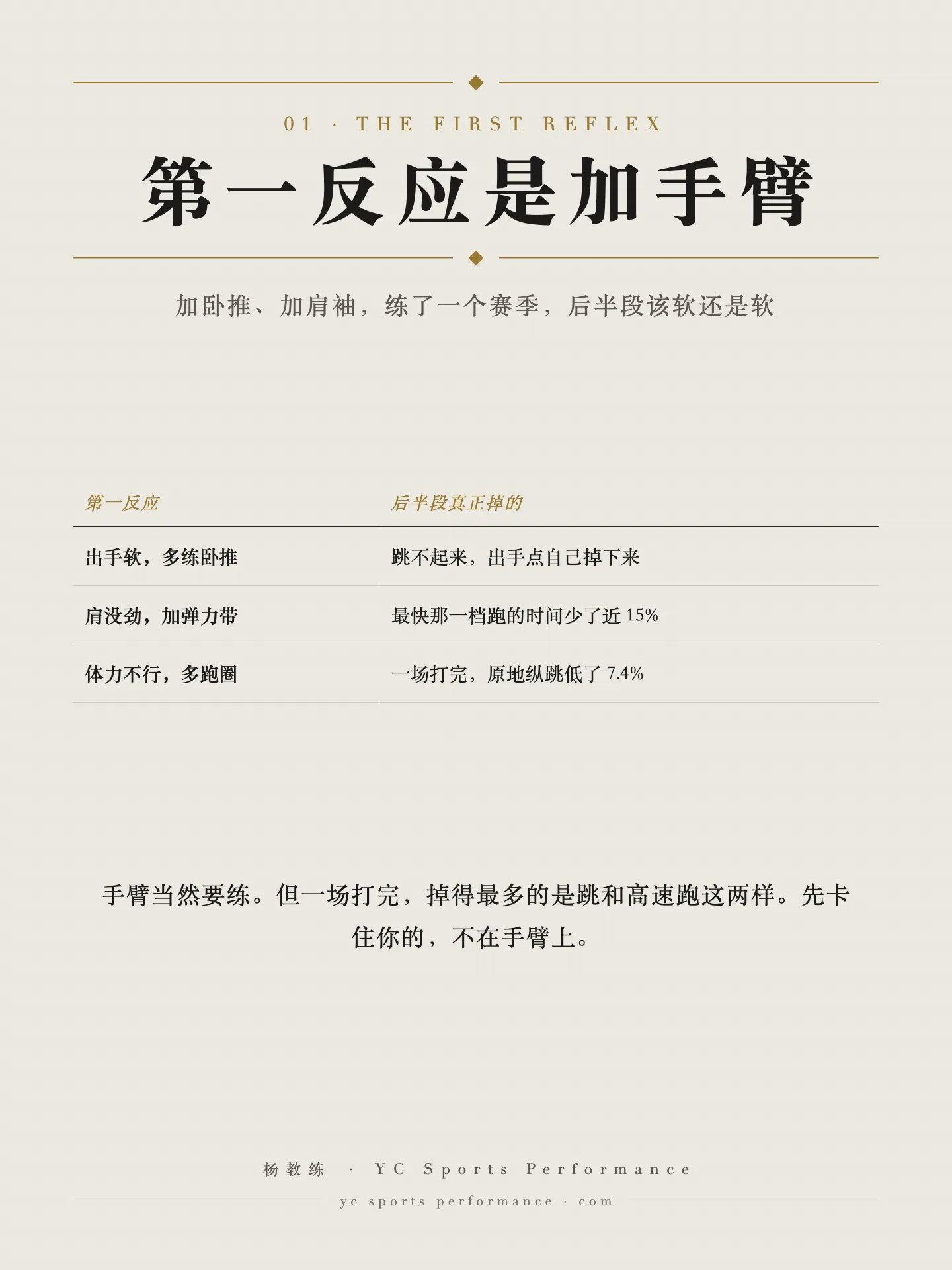

Many handball players know this: in the first half, jump shots are high and powerful, but late in the game you're still jumping, yet the ball comes out soft. The first reaction is often that arm strength isn't enough, so they add bench press and rotator cuff work. After a season, the bench press is up, and the shots still go soft late in the game. Why?
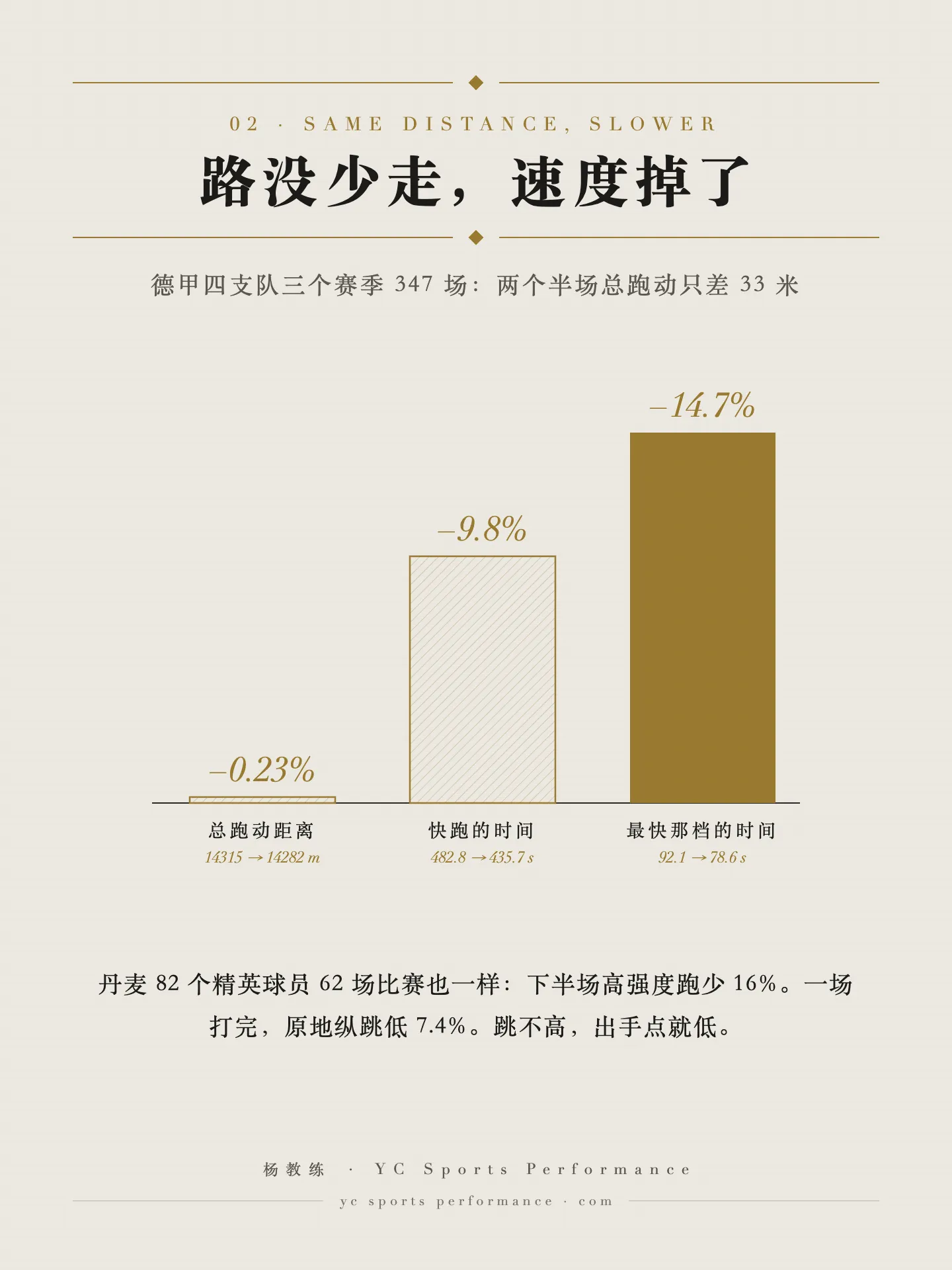
First, look at what happens late in the game. Across 347 matches over three seasons from four German Bundesliga teams, total team running distance differed by only 33 m between halves: 14,315 m in the first half, 14,282 m in the second, a 0.23% difference. The distance didn't drop at all; what changed was how it was covered: time in the fastest band fell 14.7%, fast running fell 9.8%, and jogging rose 4.9%. It's the same in 82 elite Danish players over 62 matches: second-half high-intensity running fell from 155 m to 130 m, down 16%.
And the jumping? 40 players from an elite Portuguese team were tested before and after a match: after one match, their standing vertical jump was 7.4% lower. If you can't jump as high, your release point drops, and the arm is left to make up the difference.
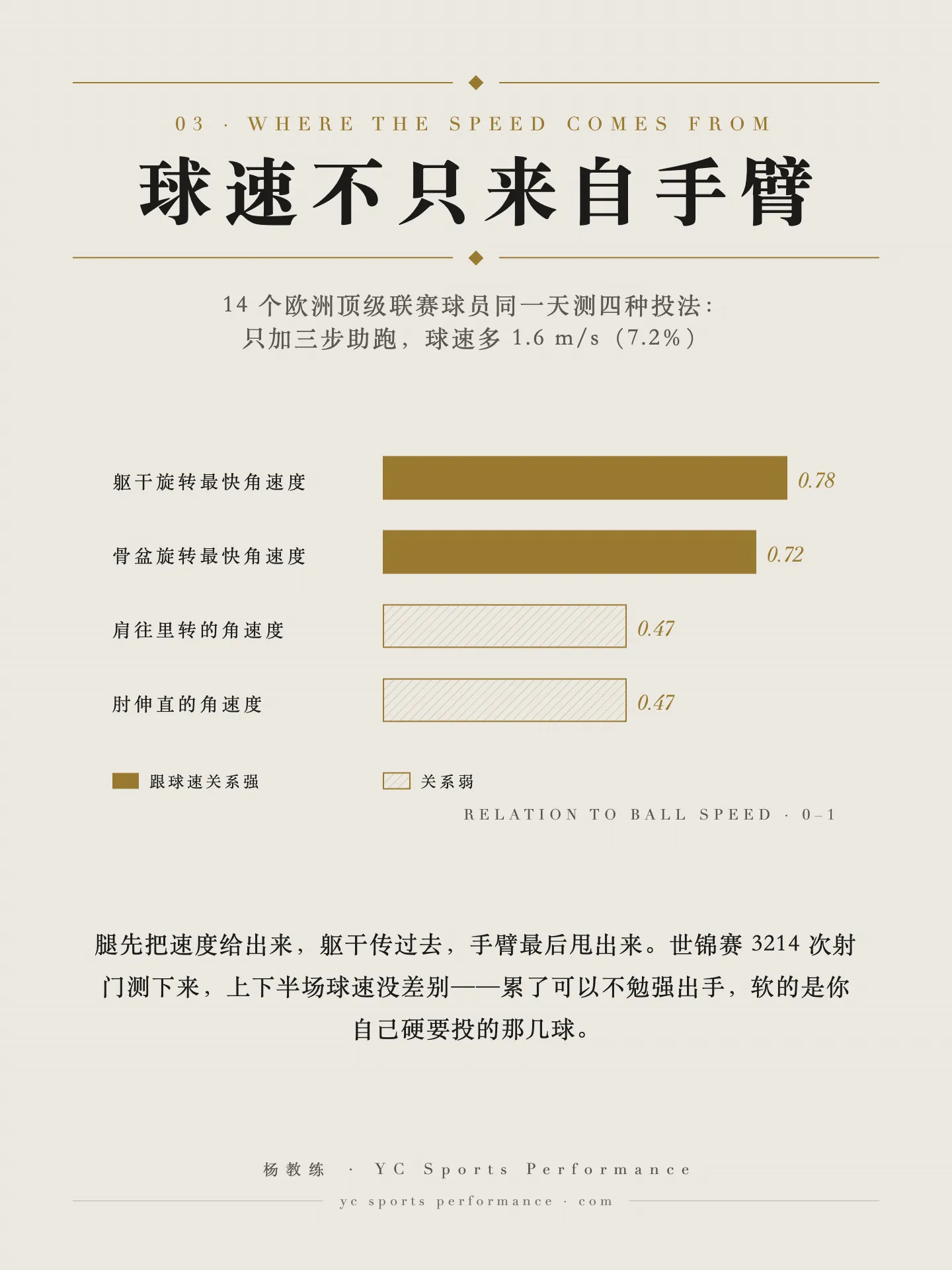
Release speed doesn't come only from the arm in the first place. 14 elite players from top European leagues were tested on four throwing styles on the same day: a standing throw reached 22.3 m/s, while a throw with a three-step run-up reached 23.9 m/s, 1.6 m/s or 7.2% faster. In the same study, peak angular velocity of trunk and pelvic rotation related to ball speed at 0.78 and 0.72, while shoulder internal rotation and elbow extension were both 0.47. The legs generate the speed first, the trunk transfers it, and the arm whips through last.
Some things didn't show up in the data. At the 2013 men's World Championship, radar measured 3214 shots across 47 matches: 22.23 m/s in the first half, 22.30 m/s in the second, no difference. In matches there are substitutions, and tired players can choose not to force a shot. So going soft late in the game doesn't mean every shot goes soft; it's the ones you force.
Train four things. Run-up take-off: running hurdle jumps, running box jumps, running single-leg continuous hurdle hops. Lower-body strength paired with power: box squats with straight-leg box jumps, squats with kneeling jumps, power cleans with continuous hurdle jumps; do the heavy one first, then follow straight away with a jump. Transferring force through the trunk: medicine ball split-stance forward throws, side shuffle into side throw. Throwing when tired: put throwing velocity work in the last part of the sport-specific session, so you throw right after acceleration runs or contact work.
Of course you need to train the arm. But what goes soft first late in the game is the legs and trunk, not the arm.
Late in the game, is it that you can't get off the ground, or that your shot has no power? Tell me in the comments.
Back to all daily posts