
YC SP.#025Tennis · 2026.10.13
Why your feet get heavier the longer the tennis rally goes
The graphics in this post are in Chinese. The text below is an English translation.




Plenty of tennis players know this: a baseline rally reaches a dozen or more shots, your steps start to get heavy, the ball arrives before you do, and all you can do is reach for it. The first reaction is that you're not fast enough or your legs lack strength, so you add sprints and squats. Your one-off sprint gets faster, but late in long rallies your feet are still heavy. Why?
Because long rallies test moving shot after shot, with only very short gaps in between. In each gap, your body has to recover and your feet have to reset for the next shot.
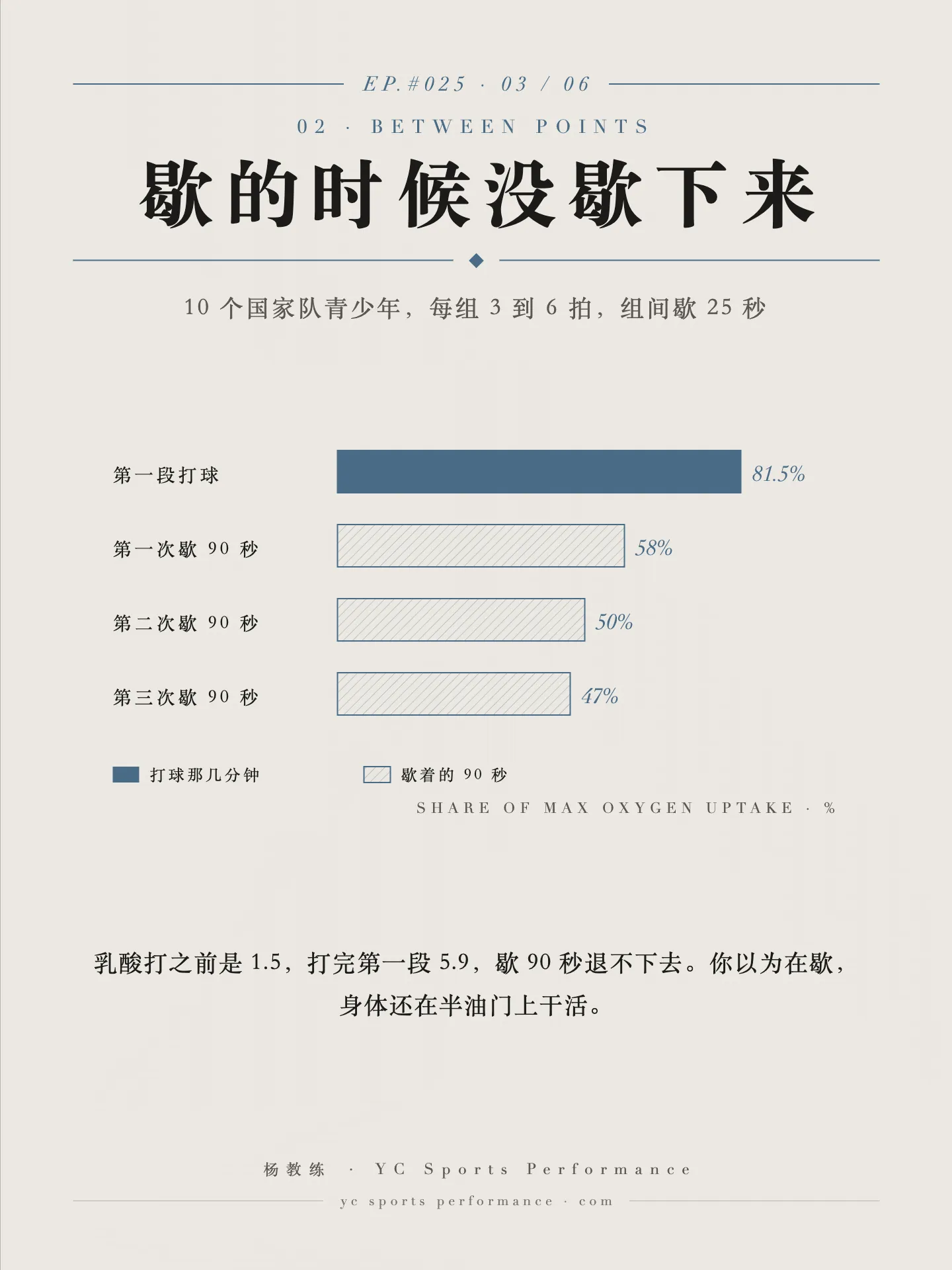
Start with recovery. A Swedish research group had 10 junior national-team players play at match tempo: sets of 3 to 6 shots, 25 seconds' rest between sets, and 90 seconds' rest after every 8 sets. While playing they worked at 77% to 81.5% of their maximal oxygen uptake, and during the 90-second rest they were still at 47% to 58%. Blood lactate rose from 1.5 to 5.9 and didn't come down within the 90 seconds. You think you're resting, but your body is still working at half throttle.
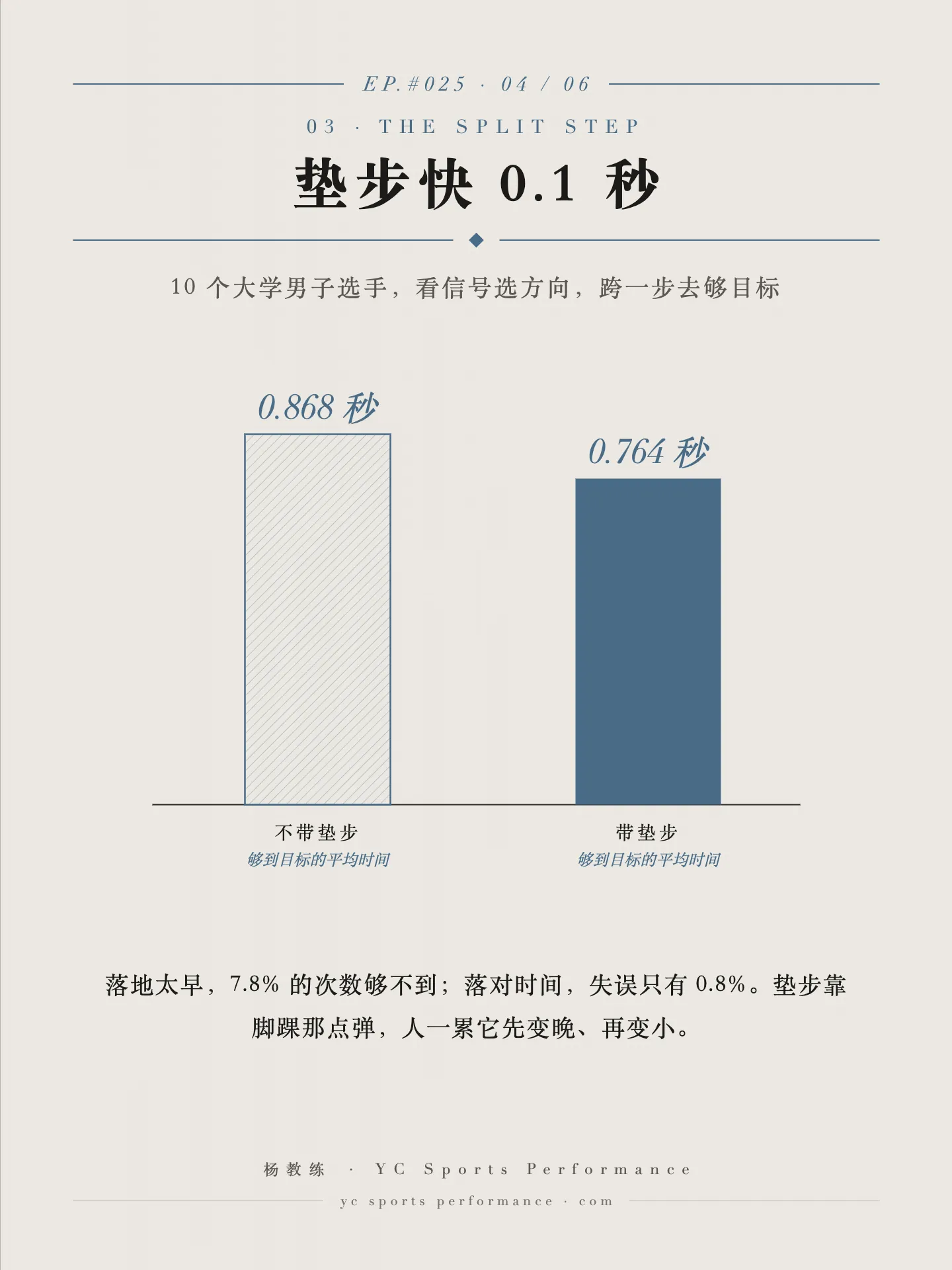
Next, resetting. The small hop on the spot just before your opponent hits, landing with your feet apart, is called a split step. In a Japanese study, 10 male university players reached a target in 0.764 seconds with a split step and 0.868 seconds without – about 0.1 seconds faster. The split step relies on the springiness of your calves and ankles. When you tire, it first gets late, then gets smaller, and finally disappears – and that's when your feet get heavy.
In a French study, 12 players played for 3 hours straight: maximal leg strength dropped by 9%, but standing jump power held up for the whole session. How high you can jump once isn't really the problem late in long rallies.
So what should you train? Four things.
An aerobic base: 15 minutes steady on the elliptical or rowing machine.
Match-tempo intervals: lateral mini hurdle shuttles, 20 seconds at full speed, 40 seconds rest, 8 sets.
Spring in your feet: small ankle hops on the spot and side to side, light and quick.
Split-step even when tired: in the last few sets of intervals, still react to a cue – split step first, then go.
How many shots into a rally do your feet start to feel heavy? Tell me in the comments.
Back to all daily posts