
YC SP.#023Basketball · 2026.10.11
Why your jump keeps dropping in the fourth quarter, even if you jump high
The graphics in this post are in Chinese. The text below is an English translation.





Plenty of basketball players know this: through the first three quarters you can still grab rebounds and put back misses, but in the fourth your legs get heavy, your take-off is half a beat slow, and after landing you clearly can't get up for the second jump. The first reaction is that your vertical isn't good enough, so you add loaded squats and practise reach jumps every day. Your reach goes up, but in the fourth quarter you still can't get off the floor. Why?
Because how high you can jump once and jumping again and again over a whole game are two different things. Loaded squats and reach jumps train the first jump; the fourth quarter tests the tenth and the twentieth.
Start with games. A review bringing together 25 studies of basketball games found that by the fourth quarter, high-intensity actions such as sprints and fast shuffles drop off clearly.
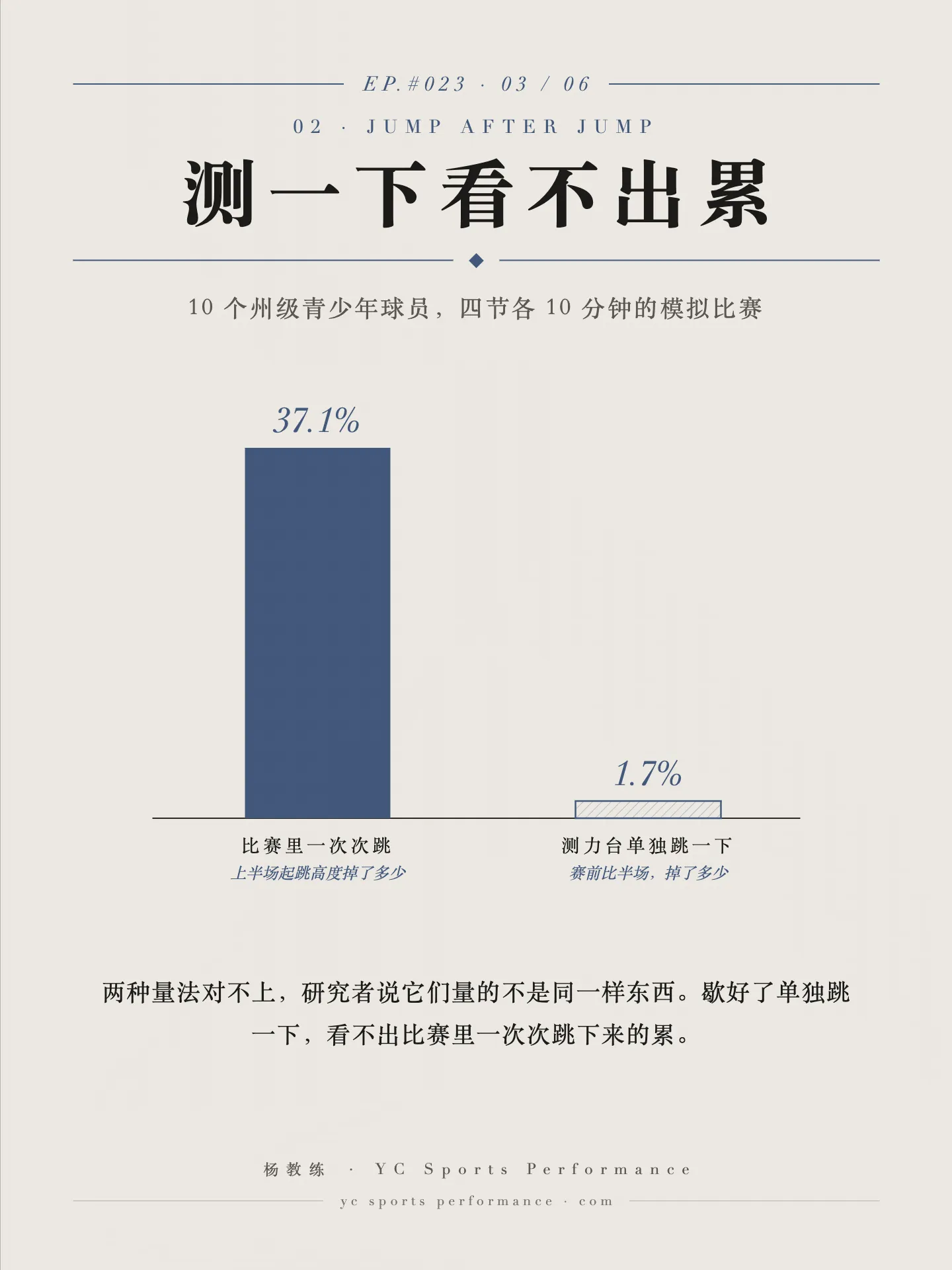
Next, jumping. In a study, 10 Australian state-level junior players played a simulated game of four 10-minute quarters. Measured across their repeated jumps during play, jump height dropped by 37.1% in the first half; a single jump on a force plate before the game and at half-time differed by only 1.7%. One jump after a rest doesn't reveal the fatigue that builds up from jumping again and again in a game.
Then there's running. In a study, 25 recreational basketball players did 10 shuttle sprints of 30 m, with 30 seconds' rest after each. Tested 2 minutes after finishing, their standing jump had dropped from 38.1 cm to 35.9 cm; after 15 minutes' rest it was still 36.8 cm, and they also dipped less deeply before take-off. Once your legs are worn down by running back and forth, you can't sink down, and you can't drive up. This is key.
In a study of 52 professional players training for 8 weeks, those who did only depth jumps improved their standing jump more, while those who combined depth jumps with shuttle sprints improved more in repeated sprints and change of direction. Jumping and running need to be trained together.
So what should you train? Four things.
Land and jump again: repeated jumps and depth jumps – off the ground again the moment you land.
Jump after running: a few shuttle sprints, followed straight away by a few jumps.
A single leg that holds: split squats, step-ups and single-leg landings you stick.
Every rep at full speed: start one every 30 seconds, and stop once you're more than 5% slower than your best that day.
In the fourth quarter, is your take-off getting slower, or can't you follow up with the second jump after landing? Tell me in the comments.
Back to all daily posts