
YC SP.#022Football · 2026.10.05
Half a beat slow when changing direction: speed or braking?
The graphics in this post are in Chinese. The text below is an English translation.
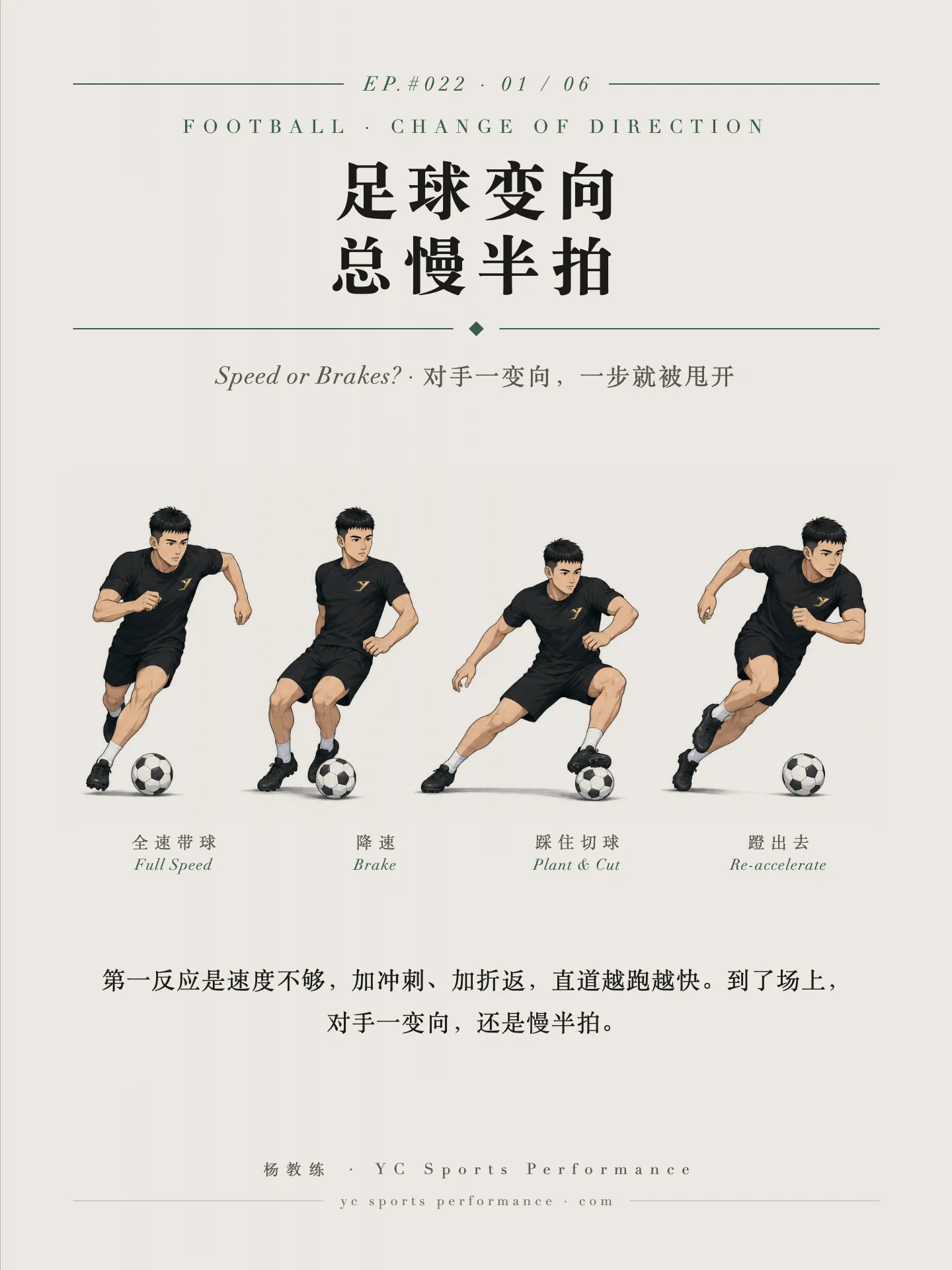



Plenty of footballers know this: your opponent changes direction, you see it, but your feet just can't follow, and one step later you've been left behind. The usual first reaction is that you're not fast enough, so you add sprints and shuttles. Back on the pitch, when your opponent changes direction, you're still half a beat slow. Why?
Because half the work of changing direction is stopping. A 2019 review compared match GPS data from 19 studies across 7 high-level team sports: in every sport except American football, high-intensity decelerations outnumbered high-intensity accelerations, and the gap was largest in football. In a match, you hit the brakes more often than you take off.
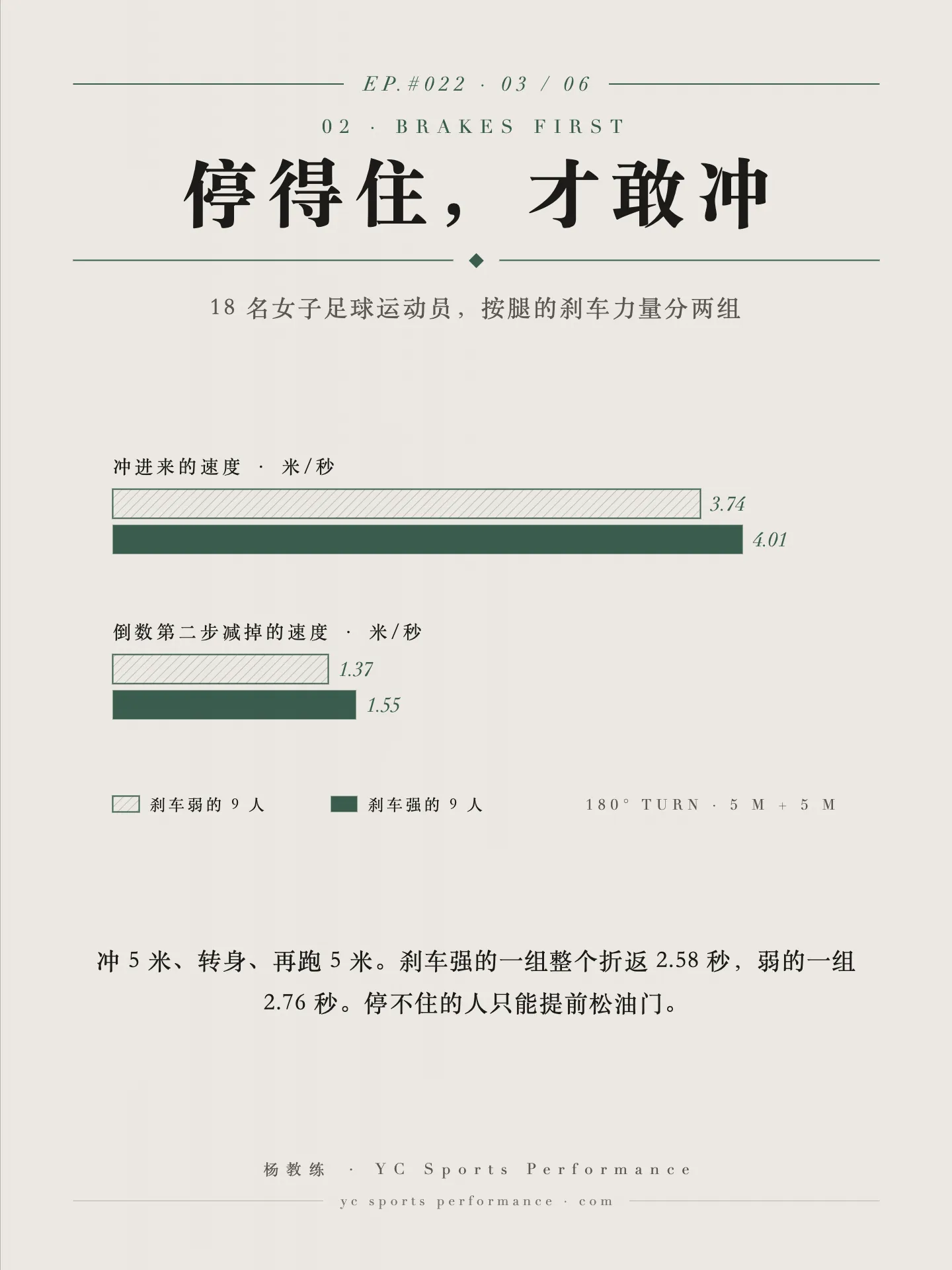
In a study of 18 female football players doing a 180-degree turn test – sprint 5 m, turn, run 5 m back – players were split into stronger and weaker groups of 9 based on eccentric quadriceps strength, the front of the thigh working as it lowers. The stronger group came in at 4.01 m per second, the weaker at 3.74 m per second; on the penultimate step before the turn, the stronger group shed 1.55 m per second in a single step, the weaker only 1.37. Over the whole turn, the stronger group took 2.58 seconds, the weaker 2.76 seconds. They could afford to come in fast because they could stop.
Why doesn't straight-line speed help? In a 6-week controlled training study, 36 men trained twice a week: one group did only straight-line sprints, the other did sprints with 3 to 5 changes of direction. The straight-line group got faster in a straight line but improved only slightly at changing direction, and the more complex the course, the smaller the gain; the change-of-direction group showed no clear improvement in straight-line speed. The two abilities have to be trained separately.
So what should you train? Four things.
Legs that can stop: lower slowly into a squat, controlling it for 3 seconds, then do single-leg drop landings and stick them.
Decelerate from the penultimate step: get your body lower one step before the turn – don't wait until the last step to slam on the brakes.
Stop, then push straight off: stick the landing, then cut off at 45 degrees, progressing to 90 and 135 degrees.
Change direction only when you see it: have a partner point or call the direction, and go only once you've seen it.
When you get left behind, is it that you can't stop, or that you stop but can't get the second step going? Tell me in the comments.
Back to all daily posts