
YC SP.#008Golf · 2026.09.21
Why training your arms alone won't make you hit the ball further
The graphics in this post are in Chinese. The text below is an English translation.
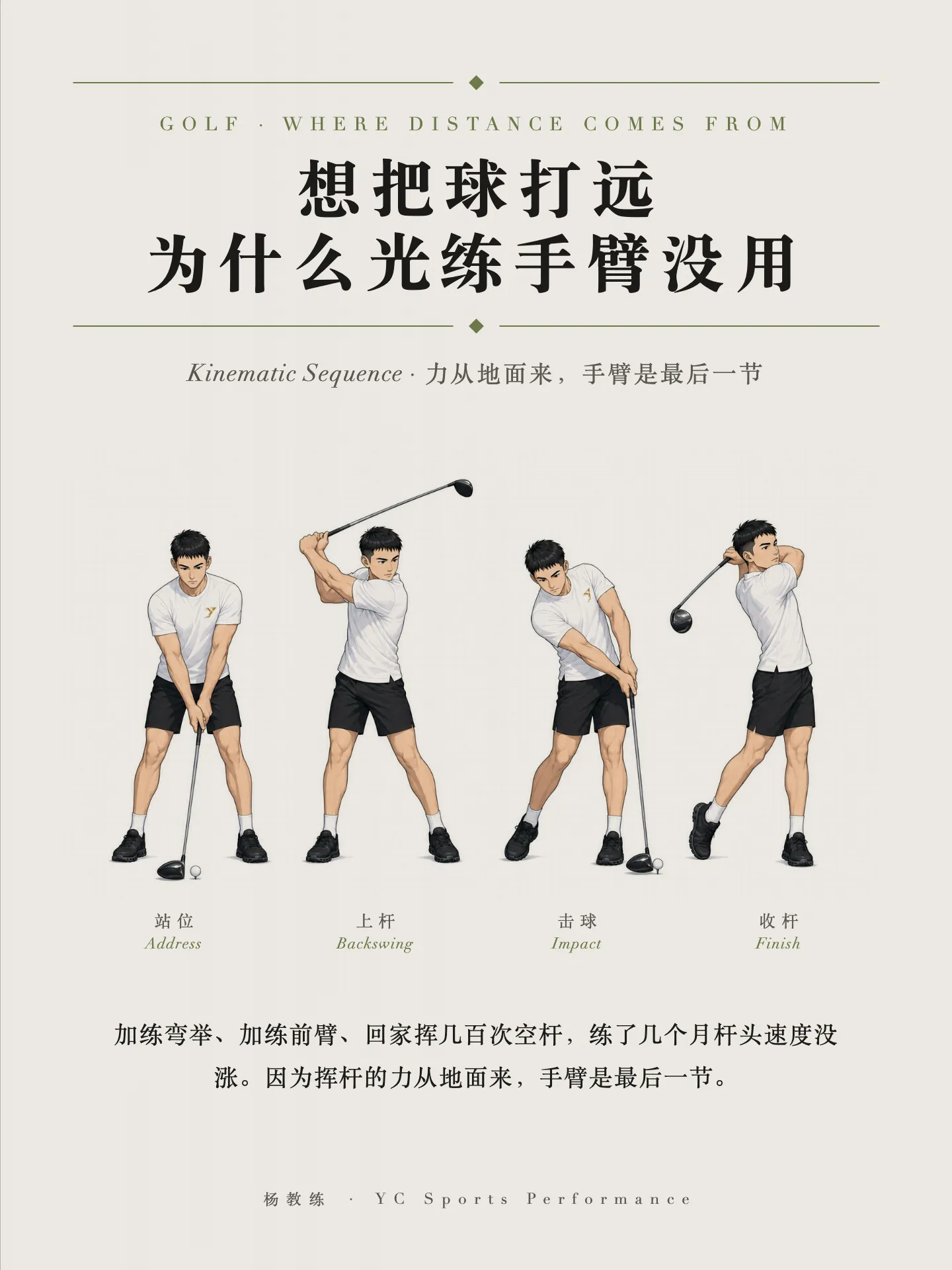

When people want to hit the ball further, the first reaction is to train their arms: extra curls, extra forearm work, a few hundred practice swings at home. Months later, clubhead speed hasn't gone up and the ball goes no further. Why?
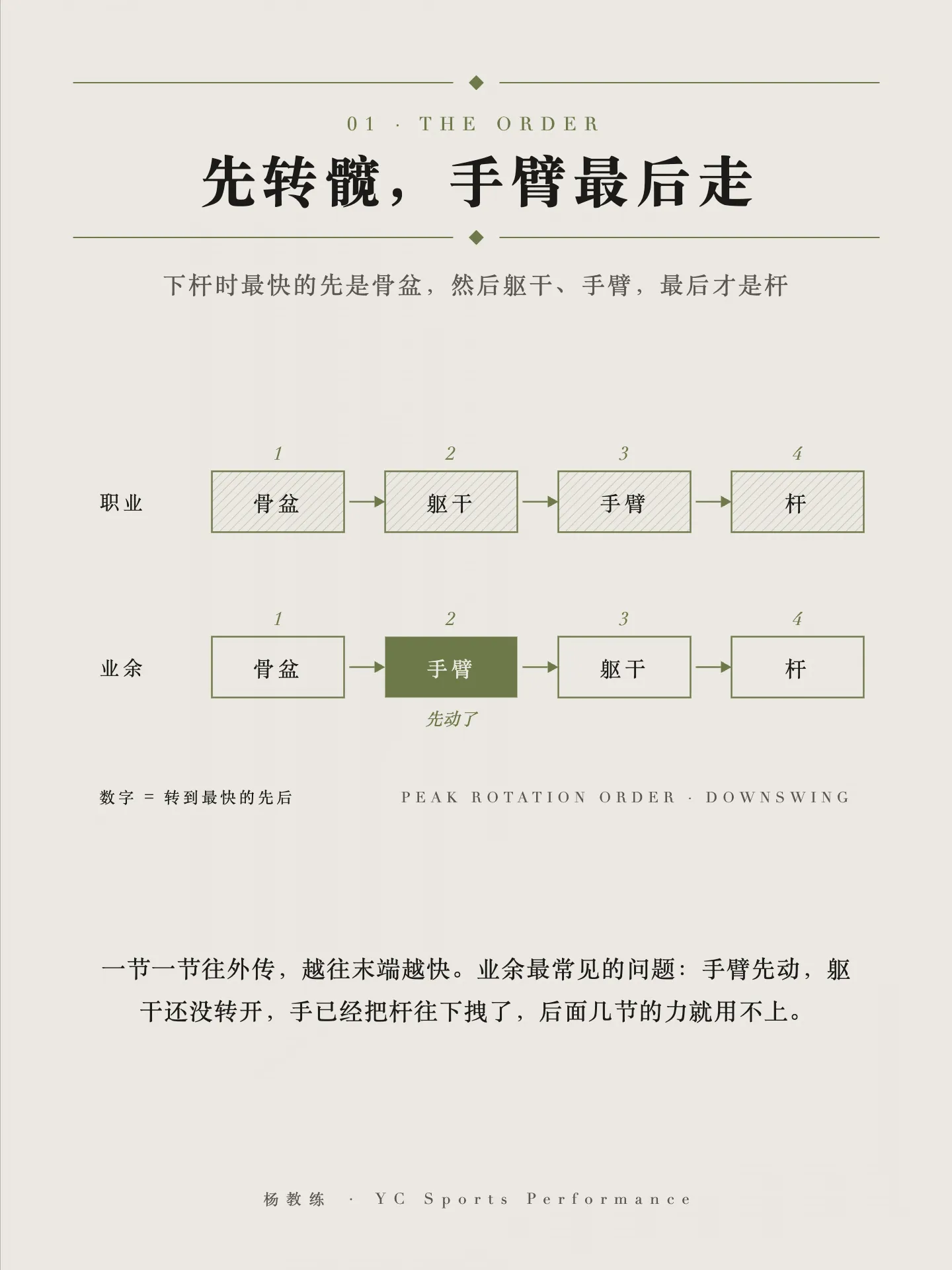
Because the force in a swing comes from the ground, and the arms are the last link. In professionals, the downswing follows a fixed sequence: first the pelvis reaches peak rotation speed, then the trunk, then the arms, and finally the club. The most common problem in amateur golfers is exactly the reverse: the arms move first, the trunk hasn't rotated open yet, and the hands are already pulling the club down. Once the arms move first, the force from the other links goes unused, and you're left swinging the club with just your two arms.
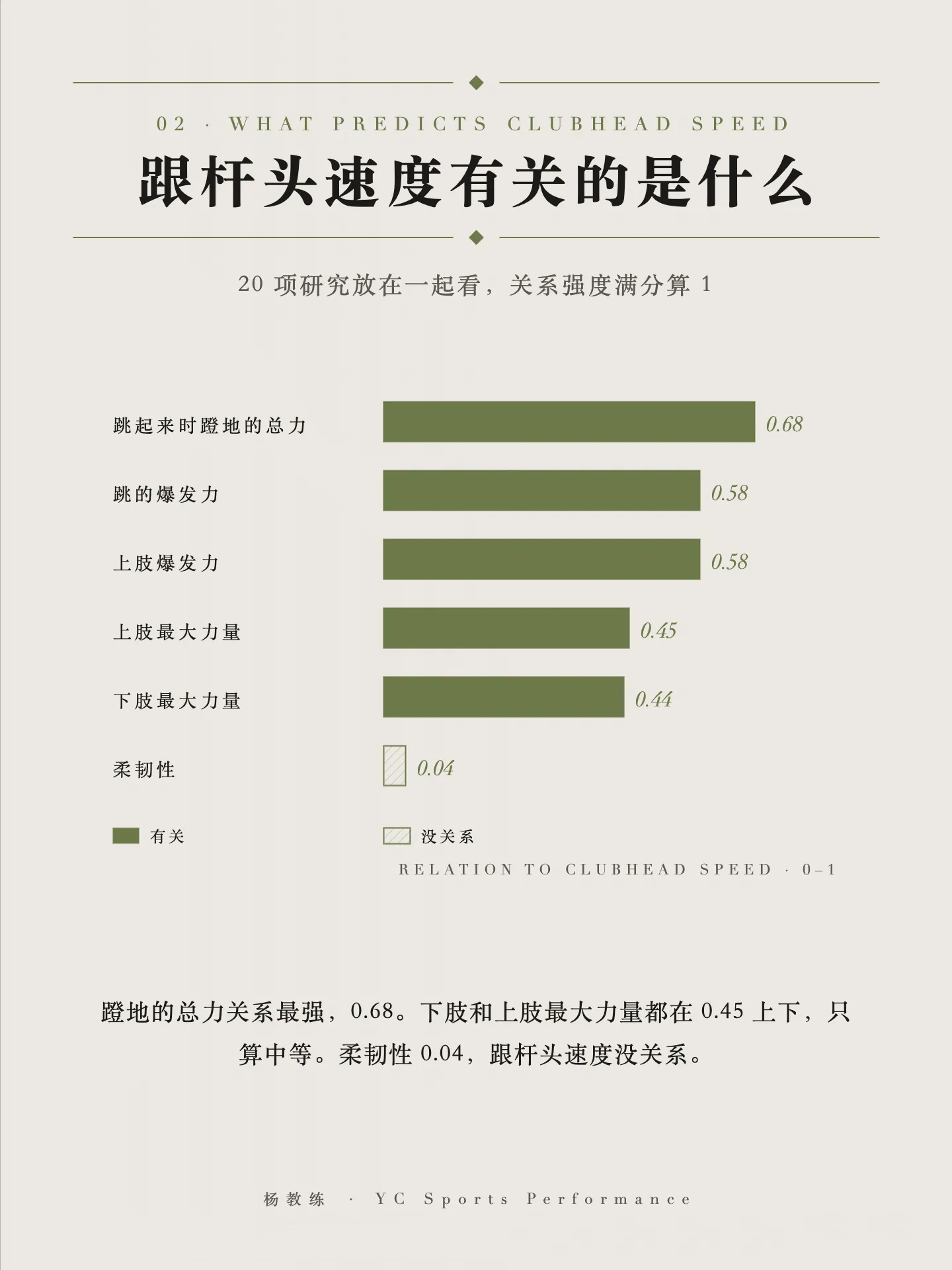
This has been measured. Pooling 20 studies, here's what was most strongly related to clubhead speed, on a scale where 1 is a perfect relationship: total force pushing into the ground during a jump, 0.68, the highest of any measure; jump power, 0.58; lower-body maximal strength 0.44 and upper-body maximal strength 0.45, both only moderate; flexibility 0.04, no relationship with clubhead speed. The authors' conclusion: power matters more than maximal strength.
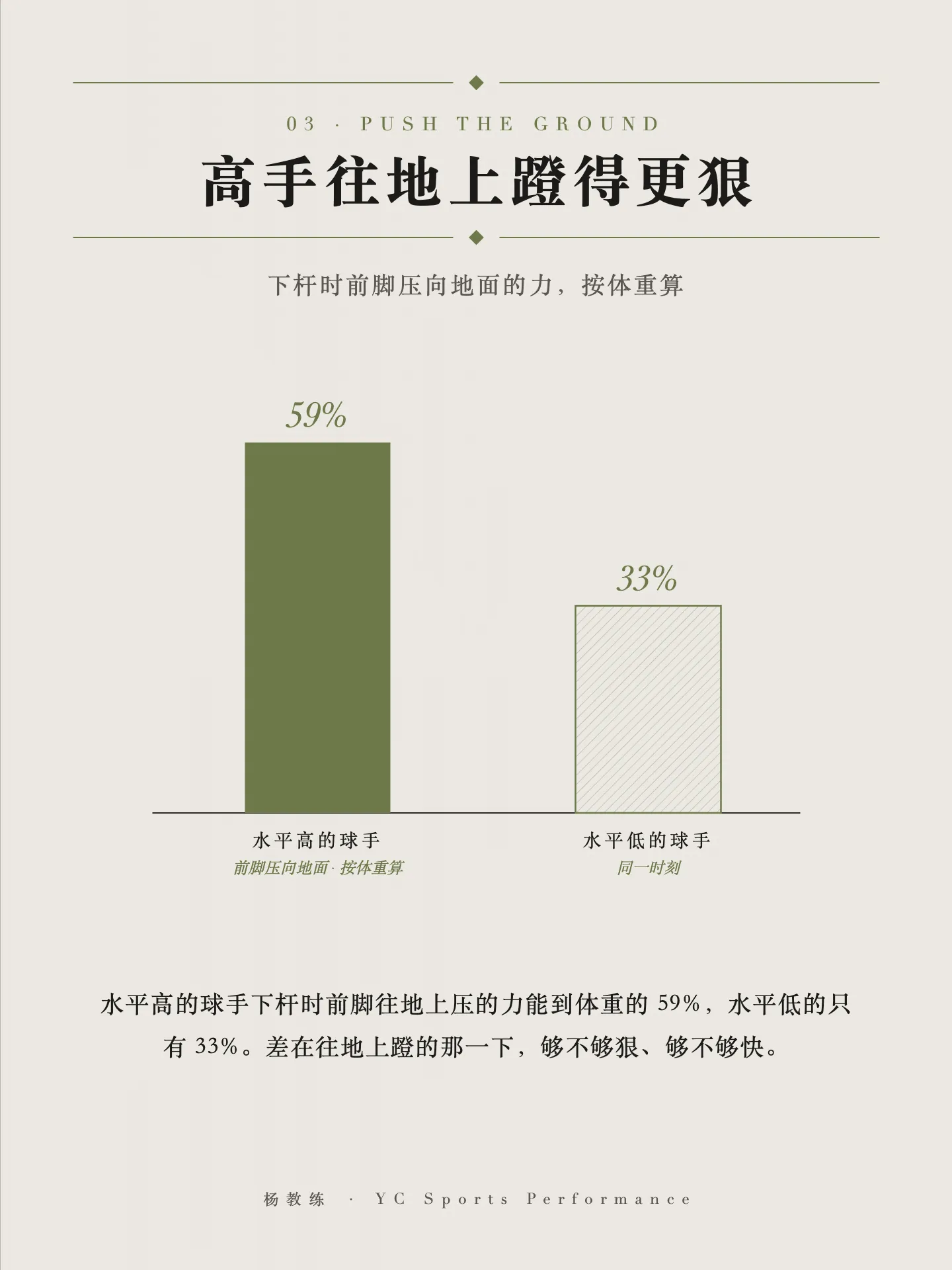
The ground end has been measured too. During the downswing, more skilled golfers press into the ground with their lead foot at up to 59% of body weight; less skilled golfers reach only 33%. The difference is in that push into the ground: whether it's hard enough and fast enough.
Of course the arms aren't useless: upper-body power is also related to clubhead speed, at 0.58. But the arms are the last link in the chain; if the earlier links aren't connected, training them on their own gives very limited gains.
How to check whether your arms move first: set your phone up face-on and film a slow-motion clip, then see whether the first move of your downswing is your hips turning towards the target or your hands dropping first.
So if you want to hit it further, what should you train? Four things, in order. One: lower-body force into the ground: squats and deadlifts as the base, then add box jumps and similar work to train speed. Two: hip-driven trunk rotation: medicine ball side throws and rotational throws. Three: sequencing: with a light club or in slow motion, turn the hips first, then the trunk, with the arms coming last. Four: upper-body power: medicine ball chest passes and plyometric push-ups, placed last.
Across 25 studies, mostly combining strength, jumping and core work, clubhead speed, ball speed and distance improved by 4% to 6% on average after training.
Which link are you training right now? Tell me your driver distance and how you train in the comments, and I'll see whether your arms are moving first.
Back to all daily posts