
YC SP.#007Climbing · 2026.09.20
Why your forearms still pump out even when your climbing strength is good
The graphics in this post are in Chinese. The text below is an English translation.
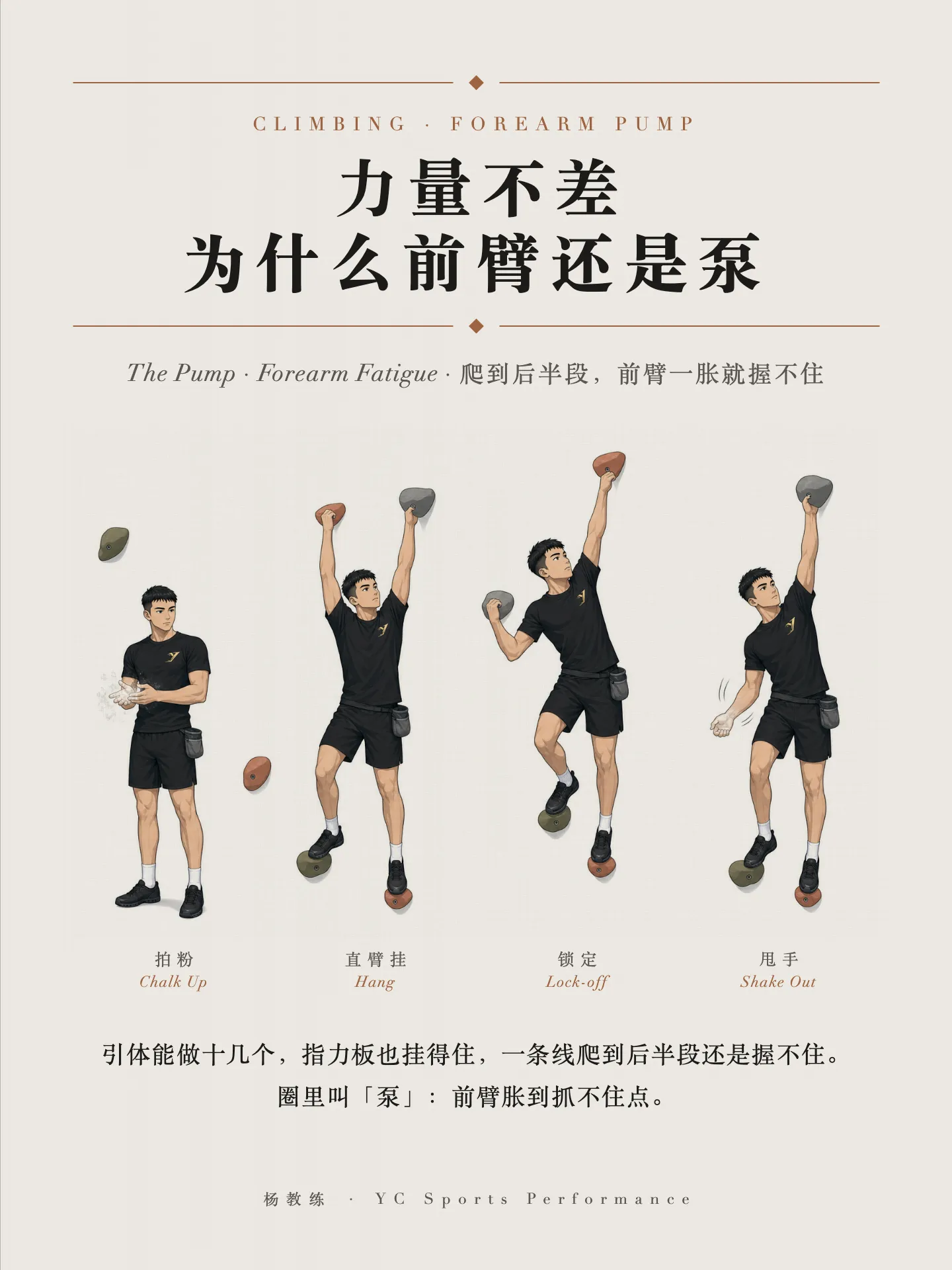

Many climbers know this: you can do a dozen or more pull-ups and hang on the fingerboard just fine, yet in the second half of a route your forearms swell and you can't hold on. Climbers call it getting "pumped": your forearms swell so much you can't grip the holds. The first reaction is usually that your finger strength isn't good enough, so you go back to more finger training. So why are you still getting pumped after all that training?
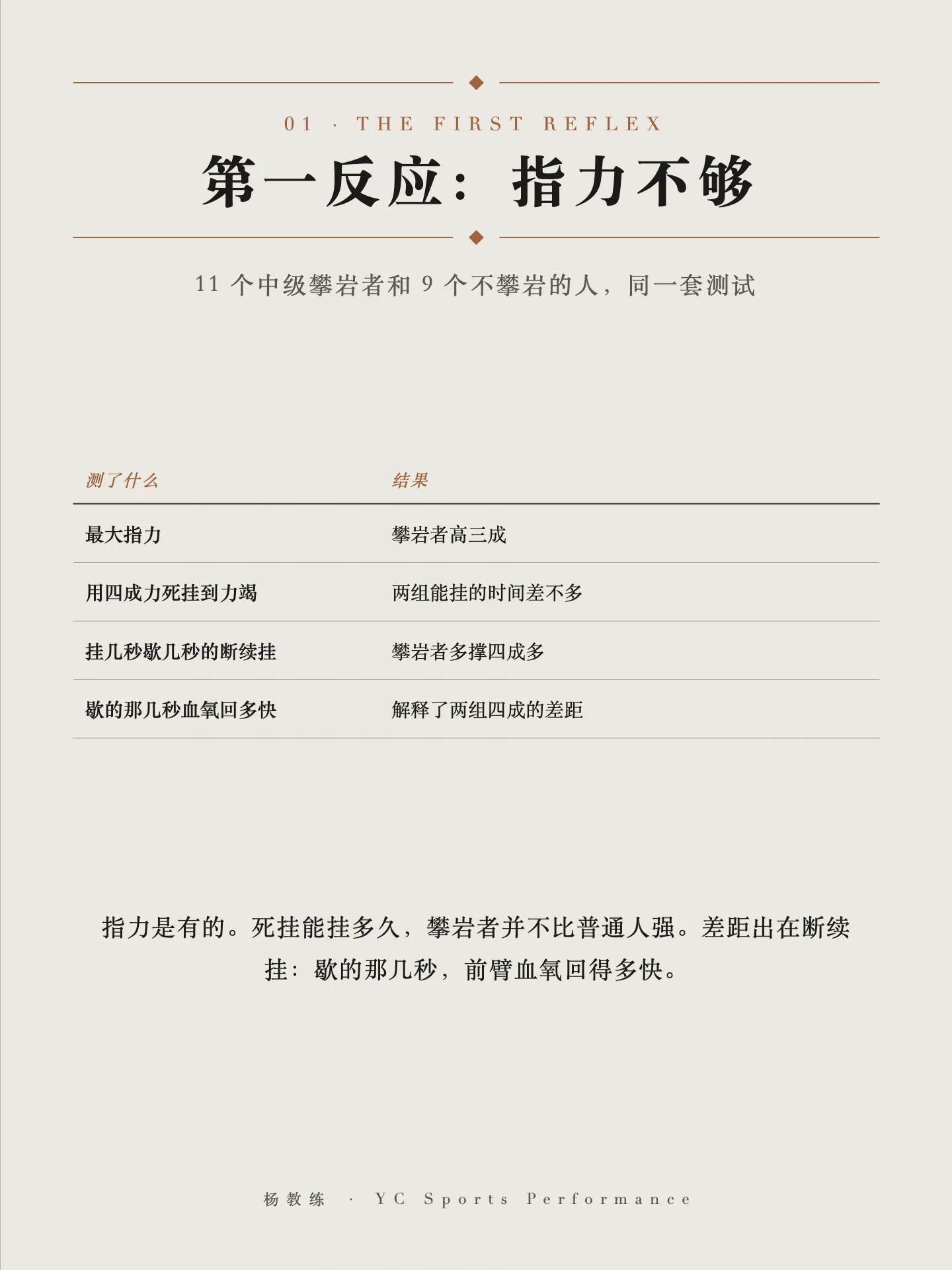
Researchers have tested this specifically. In 11 intermediate climbers and 9 non-climbers, maximal finger strength was 30% higher in the climbers. Hanging on a fingerboard at 40% of max until failure, both groups lasted about the same time. Only when the test switched to intermittent hangs, hanging for a while and resting for a while, did the climbers clearly last over 40% longer. The difference was in those few seconds of rest: how quickly forearm blood oxygen recovered, and this one measure explained the 40% gap between the groups.
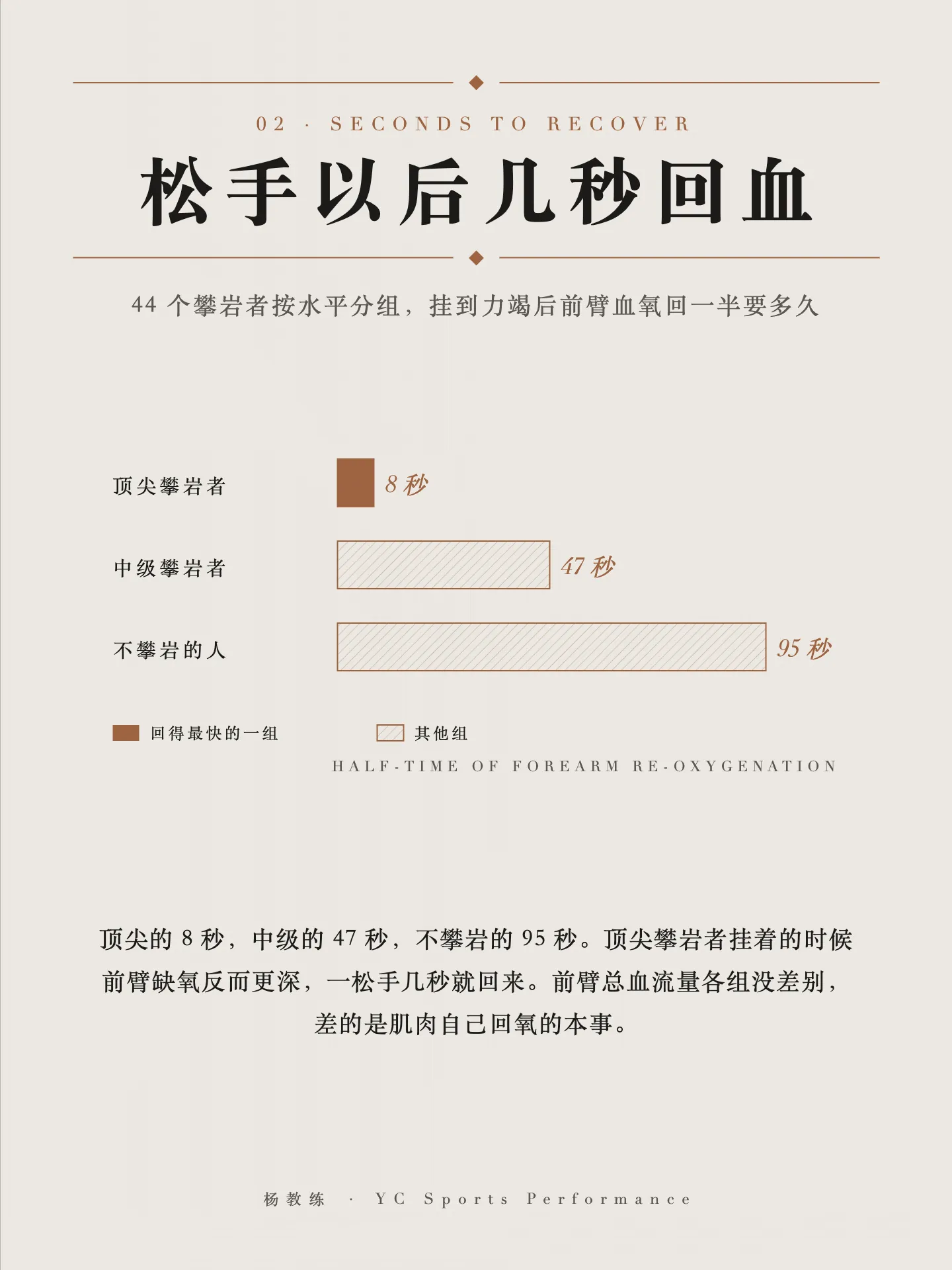
Go a level higher. 44 male climbers split into four groups by level were tested, after hanging to failure, on how long forearm blood oxygen took to recover halfway: 8 s for top climbers, 47 s for intermediates, 95 s for non-climbers. While hanging, the top climbers' forearms were actually more oxygen-deprived, but once they let go it came back within seconds. Total forearm blood flow didn't differ between groups; the difference was in the forearm muscles' own ability to use and restore oxygen.
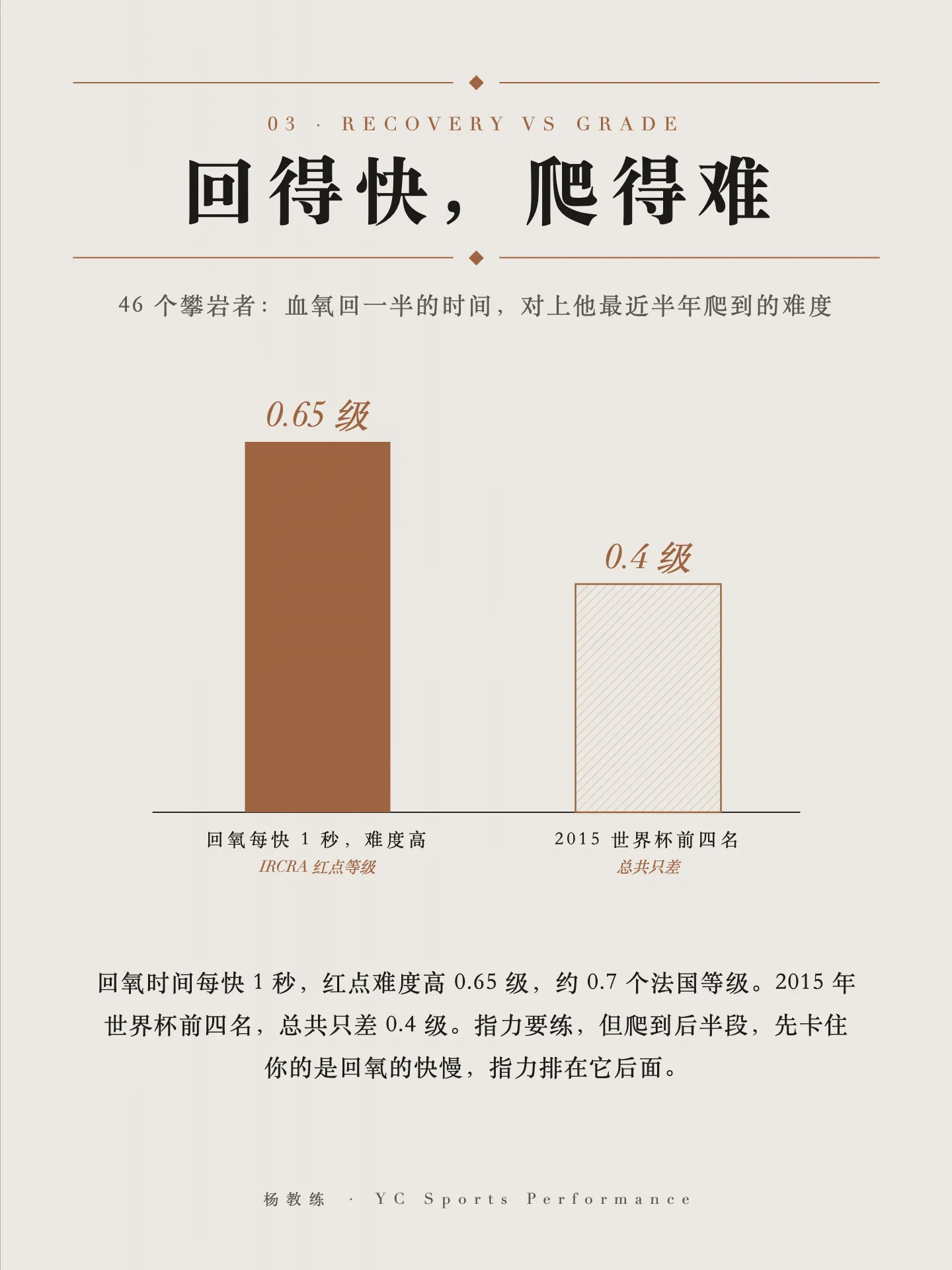
That speed maps directly onto how hard you can climb. In 46 climbers, every 1 s faster in forearm oxygen half-recovery time meant a redpoint grade 0.65 higher. At the 2015 World Cup, the top four were separated by only 0.4 of a grade in total.
Should you train finger strength? Yes, but when the problem is "getting pumped late on a route", what holds you back first is oxygen recovery, not maximal finger strength.
Train four things. First, intermittent hangs rather than continuous hangs: hang a few seconds, rest a few seconds, in sets, training blood flow to return while you rest. Second, keep training finger strength as usual, with slightly fewer sets and enough intensity. Third, body tension and footwork: feet solid on the holds and hips close to the wall, and only then do your hands genuinely save effort. Fourth, learn to rest: when resting, drop your hand down and shake it out; compared with resting with it raised, you hold on 22% longer and recover oxygen 32% faster.
Whether you get pumped depends first on how quickly you recover in those few seconds after letting go, and only then on how strong your fingers are. Get these two the wrong way round and your finger strength goes up but you still can't finish the route, because what stops you in the second half has been oxygen recovery all along.
At which hold on a route do you start getting pumped? Tell me in the comments.
Back to all daily posts